


In a university situated at the foot of Mt. Makiling, changes are happening in a foreign language class — a language traditionally considered gendered.
Daryl Pasion, assistant professor of language and culture at the University of the Philippines Los Baños, recalled one instance in his Elementary Spanish class. In one of their skits, students portrayed couples meeting their families. Pasion remembered seeing characters introducing a partner of the same sex. It was an unusual sight, and even more so, unconventional. After all, how could a gendered language be used to describe an individual who did not conform to heteronormative standards?
“I was actually surprised that the classroom was very diverse,” Pasion said. There were students who came from a single-parent family. Some grew up under the care of homosexual parents. “And many of them do not really identify with the binary of gender.”
Pasion incorporated these anecdotes into “¡Bienvenides!: A Gender-Sensitive and Gender-Inclusive Spanish Workbook for Beginners.”
The book cover of "¡Bienvenides! : A Gender-Sensitive and Gender-Inclusive Spanish Workbook for Beginners. Illustration provided by Asst. Prof. Daryl Pasion.
Tracing the root of “¡Bienvenides!”
In August 2024, Pasion began designing the workbook for his Spanish 10 class. A product of the 2024-2025 UPLB Centennial Faculty Grant he received, “¡Bienvenides!” aims to develop reading comprehension, vocabulary, and writing skills for new language learners.
Pasion said the design of the workbook is informed by the pedagogy of social-emotional learning (SEL). It is an educational approach aimed at developing students’ self-awareness, social awareness, and their ability to build healthy relationships. “‘¡Bienvenides!’ seeks and invites self-reflection and social reflection. It also promotes a very supportive environment inside the classroom,” Pasion noted.
Similar to typical Spanish workbooks, “¡Bienvenides!” covers topics such as: introducing oneself by stating one’s name, age, and nationality; giving information on family members; describing physical characteristics and character traits; discussing professions; and talking of household chores. The striking difference between existing workbooks and “¡Bienvenides!” is how these topics are presented.
Pasion explained, “Normally, when we discuss these topics in a foreign language class, the discussion is very neutral. But in this workbook, I contextualized the topics by representing varied realities and identities that we can find in the classroom.”
Pasion then shared how these topics were presented in “¡Bienvenides!” When it comes to introducing oneself, students have the freedom to introduce themselves through their lived names, chosen pronouns, and gender identities. As for the topic on family, the workbook features non-traditional family structures, including single parents, same-sex parents, and blended families.


(Photo 1) Patricia (right) introduces himself — his preferred pronoun — as Pat, his chosen name. Illustration provided by Asst. Prof. Daryl Pasion.
(Photo 4) “I love my brown skin,” says a woman of color (left) proudly. Illustration provided by Asst. Prof. Daryl Pasion.
Other topics are also studied in the context of stereotypes. When discussing professions, for instance, students not only learn about their corresponding Spanish terms; but they also learn about the gender stereotypes associated with each occupation. For example, whereas existing workbooks typically associate mechanics with men, this gender-neutral workbook features an illustration of women working as mechanics. Similarly, the workbook addresses household chores that are traditionally assigned to men and women. Women do not just belong in the kitchen; they are also depicted as career women. Conversely, there are also images of stay-at-home men and house husbands caring for their children.
Pasion said of his module: “The workbook dismantles those kinds of stereotypes that society assigns to gender, and makes existing realities more visible.”
“¡Bienvenides!” also promotes body positivity and respect for diversity. Featured are physical characteristics that are deemed “imperfections” by society. For example, students can see illustrations of individuals with body hair, birthmarks, and pimples, among others. Furthermore, “¡Bienvenides!” explores fashion as a form of gender expression. Imagine men in stilettos or in gowns. Last but not least, the workbook also includes adjectives describing personalities and attitudes.

“Clothes do not define my gender,” says a nonbinary person in rainbow-colored platform shoes. Illustration provided by Asst. Prof. Daryl Pasion.
“Basically, we introduce the use of the letters ‘e’ and ‘x,’” explained Pasion. For example, in the adjective hermoso/a, which translates to beautiful, ‘e’ or ‘x’ is used to replace ‘o’ or ‘a’. Instead of using the binary “hermoso” or “hermosa,” a person can be described as “hermose” or “hermosx” without assuming their gender.
This linguistic practice, according to Pasion, has emerged and is widely used in Spanish-speaking communities, not just in Spain, but also in Latin America. It is a practice that has emerged from the long history of the struggles of the LGBTQ+ community. Pasion added that “the movements across the globe contributed to the emergence of these kinds of linguistic practices in many other parts of the world.”
This is the origin of “¡Bienvenides!” a gender-neutral way of saying “welcome” in Spanish. Bienvenides replaces the traditional bienvenido (masculine) and bienvenida (feminine) by using a more inclusive alternative, the letter “e.”
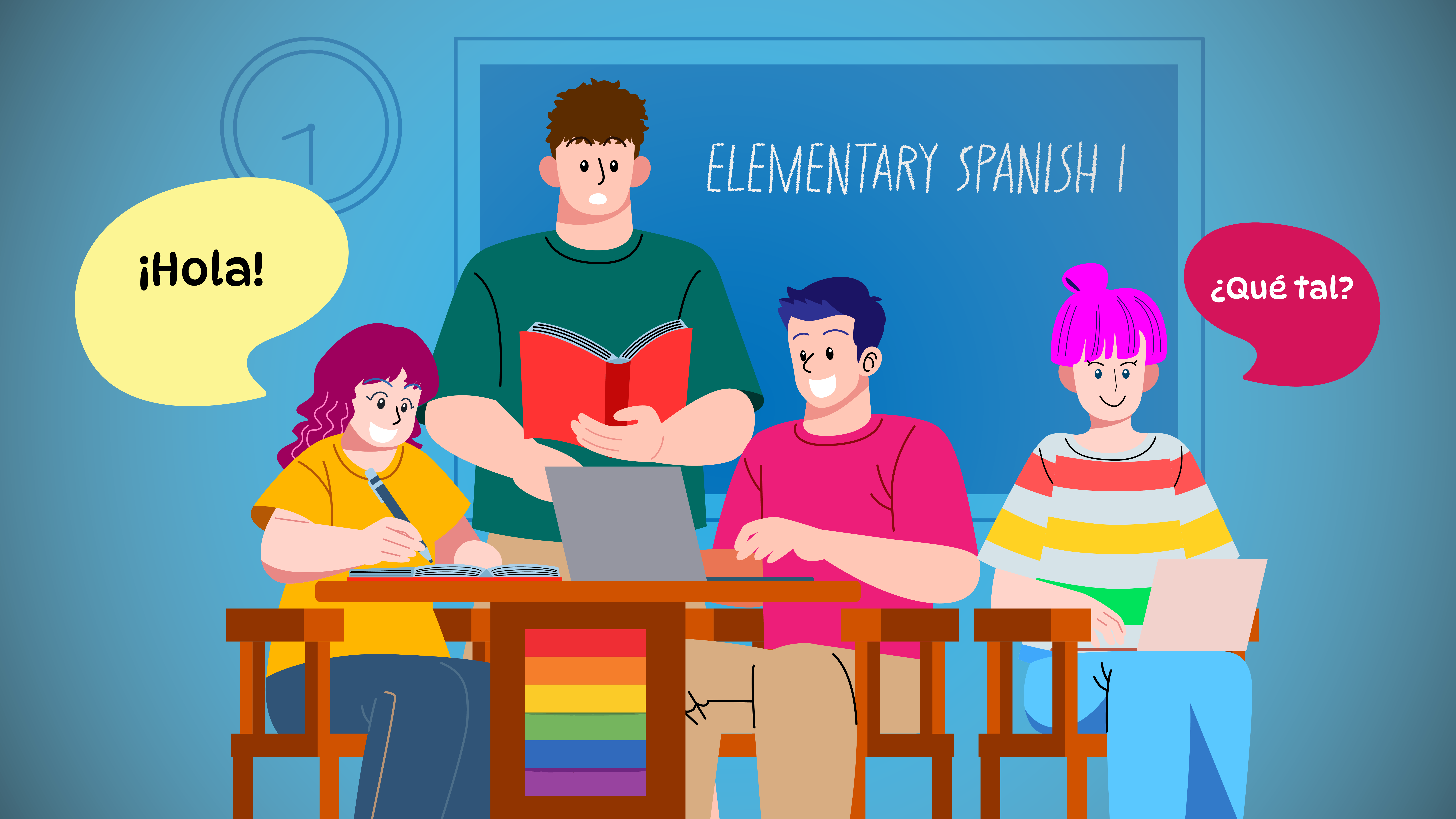
“An inclusive classroom is one that makes students feel represented,” says Asst. Prof. Daryl Pasion, a Spanish instructor at UPLB.
Emergence and resistance
Despite these unconventional and perhaps revolutionary linguistic practices in Spanish-speaking communities, rewriting the rules of language has not been institutionalized. Instead, it was met with resistance from institutions and the general public.
The Real Academia Española, the institution responsible for regulating the “proper use and unity” of the Spanish language, declared that the use of ‘e’ or ‘x’ is “unnecessary and artificial.”
Pasion shared his thoughts on the general public’s resistance to the use of gender-neutral language. He explained that discussions on inclusivity and gender-neutral language are highly “emotional.” He added that language is an individual’s personal system, “a tool to help us navigate through the complexities of our own existence.”
“When we introduce new words, these ways of naming gender identities, people would really feel like it’s a threat. It’s a threat to the already established linguistic system that perhaps helped them navigate their own worlds. When there are changes, there’s really resistance from people,” Pasion explained.
However, the emergence of new linguistic practices is inevitable. Pasion said that as society changes, so does language. “If the community does not identify with these kinds of established words, then there will really be emerging linguistic words that people can identify themselves with even more.”
“So, whether we like it or not, these kinds of linguistic practices will emerge. The linguistic landscape will change. And I think that’s where our role as teachers comes in,” Pasion added.
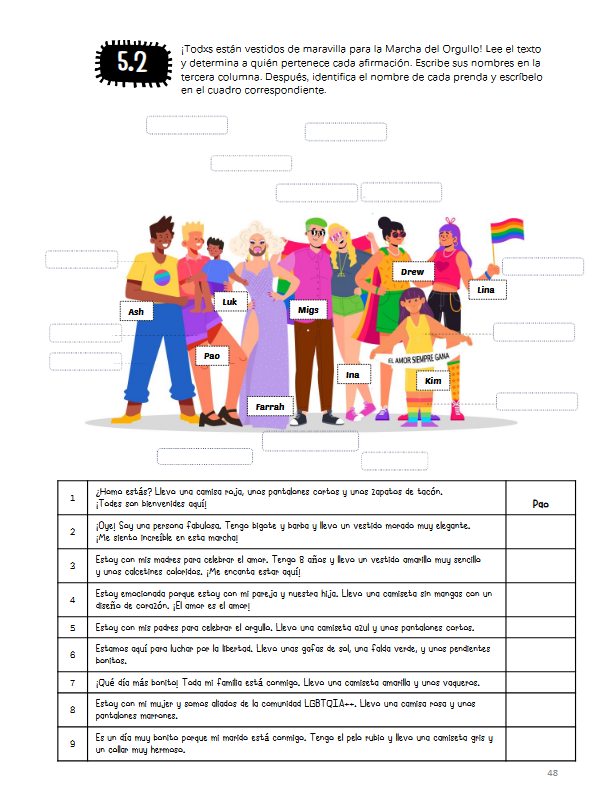
The image above is an example of the worksheets included in "¡Bienvenides! : A Gender-Sensitive and Gender-Inclusive Spanish Workbook for Beginners.” Illustration provided by Asst. Prof. Daryl Pasion.
A shift toward inclusivity
Pasion shared his thoughts on the role of language teachers in promoting inclusivity in the classroom. He stressed the need to teach students how to coexist despite differences.
“Ultimately, we want the students to be exposed to different realities,” Pasion said. “I hope that they will go out of the university with not just linguistic competence, but a better appreciation of diversity. Because when they leave the university, they will encounter people who hold different beliefs and different perspectives in life.”
While Pasion already integrates gender-inclusive and gender-sensitive activities and assessments in his Spanish class, the official use of “¡Bienvenides!” as a supplementary workbook begins in the first semester of Academic Year 2025-2026. He also intends to share the results of the implementation with his colleagues in the Language division. Pasion shared that he envisions Spanish as not being the only gender-inclusive language at UPLB.
Pasion stressed that above all, the most important aspect of this project is representation. It is fostering inclusivity in the classroom.
Pasion said that an inclusive classroom is one that is “aware” — one that makes students feel represented. He explained that “if a student is more represented, they will be more motivated to learn. They are more connected to their studies because it’s not divorced from their identity, their existence, and their experiences.”
Pasion noted that once his students began using gender-inclusive exams and assessments, they became more comfortable expressing themselves in the classroom.
Reflecting on these changes, Pasion asserted, “For me, it’s a win. These are the things that I did not personally see growing up as gay,” Pasion shared.
“So I feel like there are changes,” Pasion reflected. “Changes are happening inside the classroom.”