


UP as a refuge of art and culture
Written by Celeste Ann Castillo Llaneta
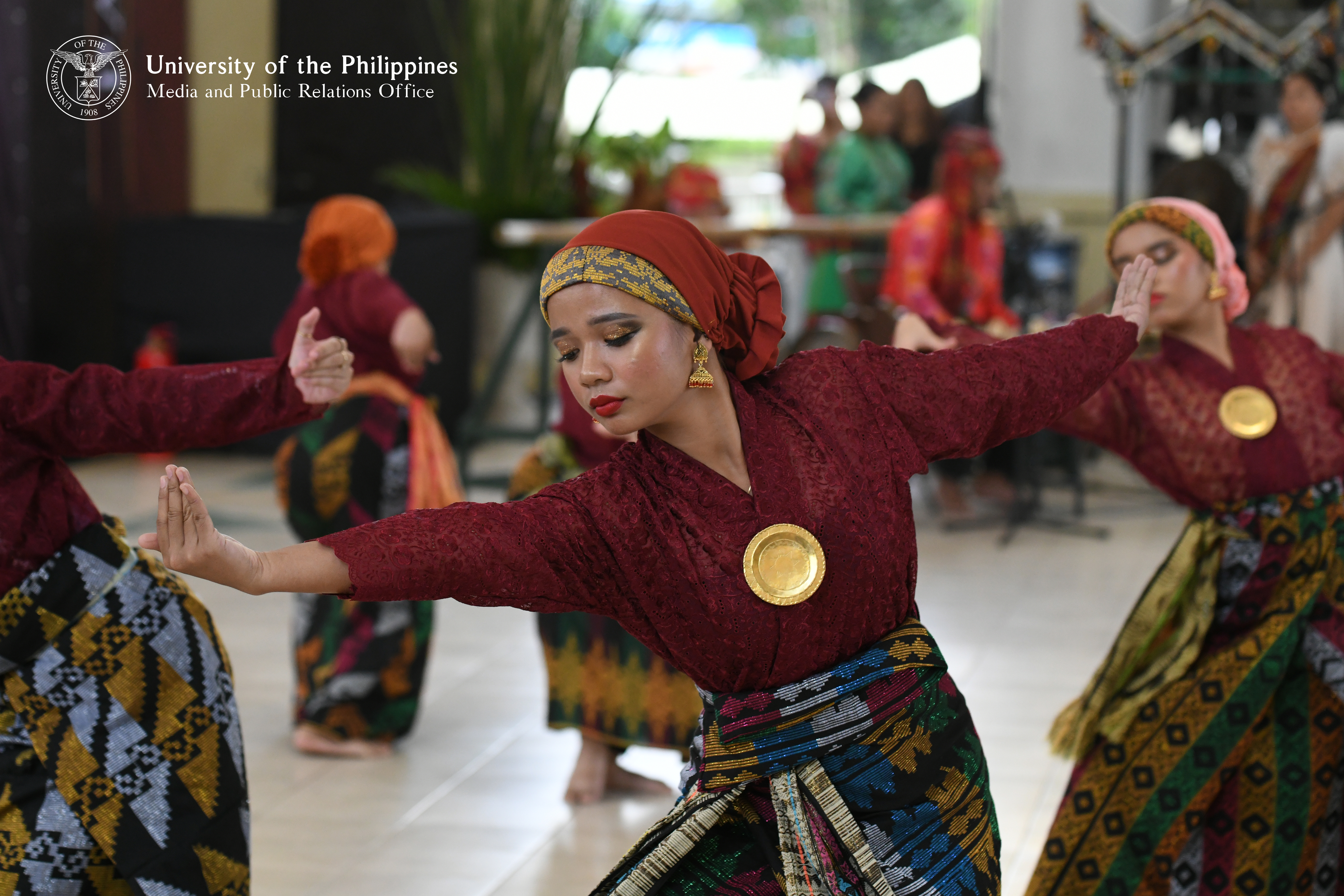
It is a well-known fact that the campuses of the University of the Philippines hold hidden treasures for those who care to look. Paintings, murals and posters adorn the walls of many buildings, and sculptures and art installations dot the verdant landscapes—all created by renowned Filipino artists and art students alike. Music performances by various performing groups, theatrical and film productions, and street performances enliven the campuses. Books, essays, poetry and other written works pour forth from the members of the UP community and find their ways into social media. In UP, the hills are alive with the sound of music, as well as the vibrancy of multimedia art, the imagined worlds of literature and theater, and the sheer diversity and exuberant freedom of creative expression.
This state of affairs, according to UP President Angelo Jimenez, is how UP must continue to be and indeed, must allow to blossom further. “Our campuses will serve as refuge for weary souls that will be rejuvenated though art and culture,” he declared in his speech during the UP Presidential Turnover Ceremony in February 2023. “UP campuses will be arts hubs. We have to maximize the use of spaces. Our campuses are good venues of found-space performances, site-specific exhibitions, community gatherings and socializations.”

The President’s Committee on Culture and the Arts
“From the very start, President Jimenez identified that he would like to place priority sa arts and culture program of the University,” said Filipino multimedia artist and assistant professor of Studio Arts at the UP College of Fine Arts (CFA) Abdulmari de Leon Imao, Jr., better known as Toym Leon Imao, who chairs the President’s Committee on Culture and the Arts (PCCA). UP’s arts and culture, he added, is part of the public-facing aspect of UP, with the arts and culture initiatives in the different UP constituent universities (CUs) serving as ambassadors of UP to the greater community. “He knows for a fact that UP needs to step up,” Imao continued. “We’re the leader. We’ve produced 44 National Artists, which is more than half of the 81 National Artists sa Pilipinas. But we can’t remain the leader for long if we don’t innovate our existing programs.”
The formation of the PCCA, a committee under the Office of the President to coordinate arts and culture initiatives in the entire UP System to maximize impact, is at the core of the UP System administration’s Flagship Program on Arts and Culture, under the aegis of the UP Strategic Plan 2023-2027, which puts emphasis on “public service through transformative education.”
“In actively harnessing its vast intellectual, cultural, and creative resources, UP is poised to reawaken not only its own soul but also the soul of the nation,” wrote Prof. Raymundo Rovillos, former Chancellor of UP Baguio and former Program Development Officer of the PCCA, in his concept paper for the proposed committee. “I agree with PAJ that as a national university, UP should open its doors more widely to society. Our culture and arts initiatives should positively impact not only our immediate UP community but also the larger Filipino community,” Rovillos noted then. “I realized that there are many arts and culture initiatives already existing in all the campuses, but many of these initiatives are known and experienced only in specific units within UP.”
Imao discussed the different prongs of the University’s Flagship Program on Arts and Culture, starting with the key concern of increasing the population of UP students taking arts and culture-related programs in the UP System. “We’ve been stuck with this quota for decades already, and we cannot [increase the population] because there is a need to also increase the infrastructure and of course the faculty and the staff behind it.”
Nurturing more artists and cultural workers

One of the prongs of the Flagship Program within the next five years is the aggressive development of new arts and culture programs in the University, starting with an art and cultural objects conservation program at the UP CFA, the first in the country. This initiative, which was started during the time of UP President Danilo Concepcion, aims to institute arts and cultural objects conservation programs at both the undergraduate and graduate level. Such a program, according to Imao, has already received the blessing of the National Museum given how few professionally trained art conservators are in the country, and would serve as a key element in the creation of a national center for arts forensics, which would serve not just the country but the Asia-Pacific region.
Of course, this program would require specialized infrastructure, a future National Institute for Art Conservation, to be built. “There’s a plan to create a four-storey facility sa Fine Arts complex in Diliman, and in the past year, we’ve been benchmarking abroad and networking with existing conservation facilities and schools and institutions outside the country to plan this out,” said Imao, who hopes that the funding for the facility will be next in the line of priorities by 2026. “Pero tuloy-tuloy ang paggawa namin sa curriculum at coursework associated with it.”
Increasing the number of arts and culture students in UP also means developing the existing Fine Arts programs at UP Baguio and UP Cebu further as well as creating new programs—and again, this will require new infrastructure. Imao also noted UP Mindanao’s potential as “fertile grounds for an arts program,” such as Fine Arts, Studio Arts or Visual Communication programs.
Arts and culture programs across the UP System
Another prong, and one of the primary roles of the PCCA, is coordinate all the autonomous arts and culture programs and initiatives in each of UP’s CUs, and to find common ground among them “para magkaroon ng awareness na hindi tayo parang mga island-constituent universities lang,” said Imao. Of course, this goes for all arts and culture disciplines in UP, from Fine Arts to Music to Theater to Architecture to Malikhaing Pagsulat. “Mas magiging vibrant ang exchanges not only in terms of faculty but of student works. Not just workshops, we’re talking about collaborative productions, exchanges of knowledge—mas paiigtingin iyon as we develop the necessary infrastructure to do that.”
Boosting infrastructure development also means ensuring the completion of existing infrastructure development programs, such as those ongoing at the UP College of Music and the UP Theater. Plans for the construction of new performance venues—which, according to Imao, are badly needed in the country—are currently in the works, beginning with the possible creation of a “performance complex” in UP Diliman to serve especially the communities in Quezon City.
Institutionalizing art education
Yet another prong for UP’s arts and culture program is addressing the urgent need for institutionalized art education. “Nakakalungkot na ang trend ngayon is that pakonti nang pakonti at nagiging marginalized ang art and culture education, especially in public schools kasi walang formal training,” Imao lamented. “So here in Diliman, we have the National Institute for Science and Mathematics Education Development (NISMED),” which has been existence for decades. “Bakit di tayo gumawa ng counterpart niya [sa arts and culture], di ba?”
This would also serve the UP System administration’s aim to reach out to the state universities and colleges, as well as other academic institutions, to help in improving the quality of education in arts and culture, so that the country’s higher education system as a whole would start producing well-trained arts and culture teachers. “If you train teachers with the necessary skills and knowledge sa arts and culture, they become cultural stewards of their individual locality no matter how far-flung,” Imao explained. “So kung merong nade-desecrate o nade-degrade na historical o cultural artifact o heritage sa kanilang community, they have the basic knowledge to identify and to know what needs to be done. And may multiplier effect ‘yan sa mga estudyante, kasi these are basically going to be the teachers who are going to be trained to share kung ano ang espiritu ng kultura ng ating bansa, which is our soul na nasa arts and culture natin.”
Finally, the UP arts and culture program will be focusing on the new innovation in art: art hybridity, at the heart of which is collaboration. “Gusto naming ayusin ‘yung collaboration and networking with other colleges, so you’ll have the opportunity to work with the College of Science, the College of Engineering, and so on. The cross-pollination between the different colleges, malaking bagay ito, kasi ‘yung environment natin ngayon, all aspects of human interactions right now, especially ‘yung internet, is hybridity.”

The uniqueness of UP’s constituent universities
Big dreams take many little steps, and for the Flagship Program on Arts and Culture, “what’s important is each individual CU identify their own particular needs,” said Imao. “They have to map out their dreams and to somehow plan out how to engage the community, not only to deliver content but be part of the production of that content, because we can only survive as a national university if we have the public support. Hanapin nila kung anong unique within their own particular areas, identify their strengths and strengthen them some more, in order that each CU would have a specific identity and forte na mapakikinabangan ng mga other CUs.”
Ultimately, though, all that needs to be done is to provide UP’s artists, performers, writers and cultural workers a common space where they can gather together and collaborate. “In essence, alam mo sa mga creatives, you just need to bring them together, and they’ll work their magic. Very organic ang process ng art eh. You bring these people together, they talk about things, uusbong ‘yan. That’s the spirit of collaboration. And that’s what we’re trying to offer, these venues and opportunities for them to meet up and create.”
More on UP’s Strategic Plan 2023-2029
Flagship Program 1: Academic Excellence
Flagship Program 2: Inclusive Admissions
Flagship Program 3: Research and Innovation
Flagship Program 4: Open and Distance e-Learning (ODeL)
Flagship Program 5: Archipelagic and Oceanic Virtual University (AOVU)
Flagship Program 6: Active and Collaborative Partnerships
Flagship Program 7: Arts and Culture
Flagship Program 8: Expansion of Public Service Offices
Flagship Program 9: Quality Management System (QMS) and Quality Assurance (QA)
Flagship Program 10: Digital Transformation