


Artwork by Tricia Mabale, UP MPRO
UP scientists are growing wild seaweed on land to reclaim lost diversity
In the UP Marine Science Institute’s (MSI) 5-hectare Bolinao Marine Laboratory, Pangasinan, a peculiar type of gardening is currently being done. Here, rows of aquariums and huge concrete channels called raceways are pumped daily with filtered seawater from nearby Guiguiwanen Channel to nourish the valuable specimens growing inside.
This place is a nursery. A seaweed nursery, to be precise. In this site, the MSI’s Algal Ecophysiology (AlgaE) Laboratory led by Dr. Michael Roleda stores and breeds wild seaweed varieties collected across the country. They study their growth and carefully track differences in traits visible and invisible to the naked eye.
The UPD-MSI's Wild Seaweed Nursery in Bolinao
Photo by the AlgaE Lab
This is no mere academic exercise. For the team, the goal is clear: to make the industry that feeds and employs so many, especially in the poorest regions of the Philippines, as catastrophe-proof as possible.
While seaweed farming remains a steady contributor to the Philippine economy, it is hobbled by problems spanning 60 years, since seaweed was first commercially cultivated here.
Roleda’s team hopes that with modern molecular techniques, they can help stave off disaster. But that only happens if we play our cards right.

JR Gacura of the AlgaE Lab holds a specimen of Betaphycus
Photo by the AlgaE Lab
A Watery Mess
Ever since he returned as a Balik-PhD researcher in 2018, Roleda has strived to make the value of seaweed and the reasons we farm it better known. The majority of commercially farmed Eucheumatoids or red seaweed are actually harvested not to become food toppings like lato, but for precious carbohydrates processed from it called carrageenan.
“Carrageenan acts as a thickener or emulsifier in almost all our food,” he said. “Spam and ice cream for example. We process beer with carrageenan to make it more clear. It is also the reason why, for instance, your toothpaste, makeup, or shampoo is not a watery mess.”
The global demand for carrageenan is tremendous. In 2022, almost 1.5 million tons of seaweed were harvested from the Philippines alone, making it a multibillion peso industry. We rank 4th among the world’s top producers, with seaweed mainly creating livelihoods in southern coastal communities.
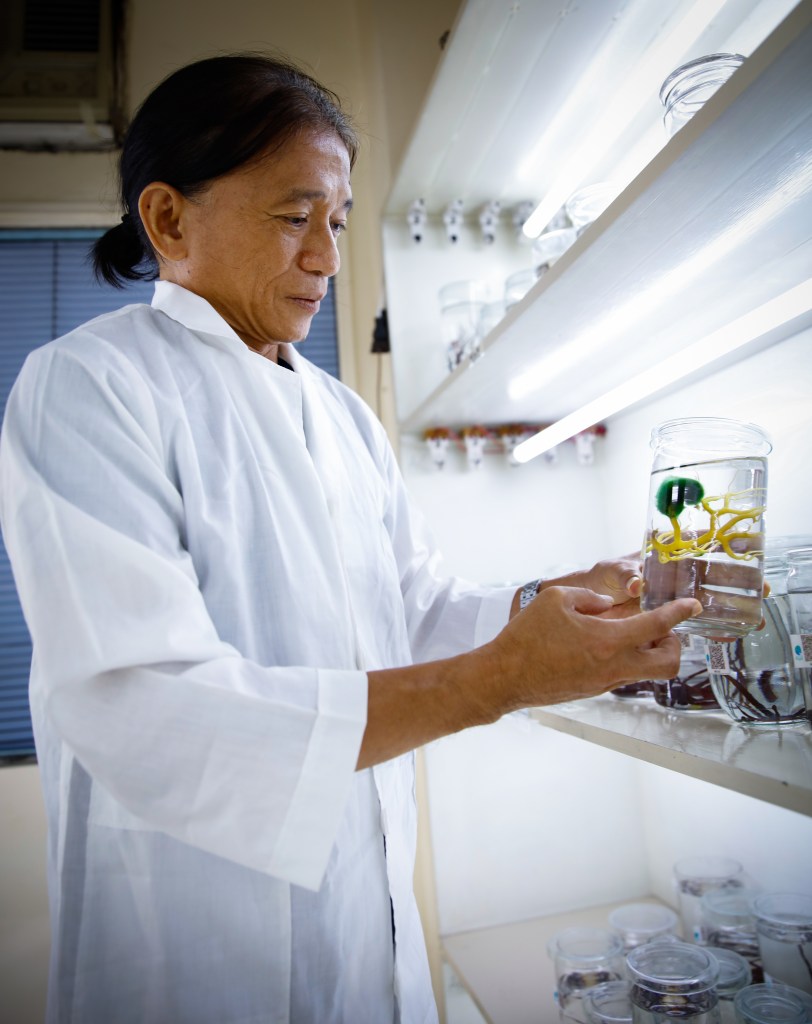
Dr. Michael Roleda inspects a specimen in his UP Diliman lab. Photo by Misael Bacani, UP MPRO.
Recently, however, seaweed farmers from areas like the Bangsamoro Autonomous Region in Muslim Mindanao were reporting alarming trends. Not only were farms gradually losing productivity, but the seaweed itself was deteriorating. Many reported thinning branches, as well as failing crops due to conditions like ice-ice disease, which bleaches seaweed white and eats away at their tissue.
Roleda’s team immediately narrowed things down to a few suspects. First was, surprisingly, genetic fatigue due to an extreme lack of genetic diversity. The truth is, despite the range of physical appearances and local names of cultivated red seaweed across the country mostly share the same genetic makeup from, at worst, a single source. These variants had seemingly lost their vitality.
How did this come to be? Mostly, it boils down to how the market encouraged farmers to select the fittest seaweed types and how they were propagated.

A partner seaweed farm of the AlgaE Lab in Taytay, Palawan
Once farmers in the country found plants with the best combination of growth rate, carbohydrate production, and toughness, Roleda thinks they started sharing them with each other through a process called “clonal propagation”.
Imagine if you cut off a person’s arm and that arm grew into an entirely new person with the same genes as the original. Now repeat that multiple times over 60 years and you end up with a situation similar to today’s.
A lack of genetic diversity can also mean that once a catastrophe hits, it has the potential to sink the entire industry. To compound these problems, the team also observed behavioral changes over time that might hold more weight than even the genes.
“We noticed that seaweed farmers don’t work as hard to maintain their farms, unlike when it all started 60 years ago,” Roleda remarked. “The standard practice used to be that farmers visit their farms every day to maintain them and clean off sediments and epiphytes.”
“But now when we ask, they say they go there every fortnight. As if it were magic that once you plant they will just continue to grow unproblematically.”
“Imagine if you cut off a person’s arm and that arm grew into an entirely new person with the same genes as the original. Now repeat that multiple times over 60 years…”
AlgaE Lab's Shienna Gonzaga Observes Seaweed Reproduction
Photo by Misael Bacani, UP MPRO
Land Nurseries
Despite these challenges, hope remained. Unlike the artificial pressures faced by cultivated seaweed, wild strains do not face the same diversity bottlenecks. Roleda’s team thus set out on a mission to reintroduce that diversity back into the commercial pool.
In a 2022 paper, the team gathered 10 wild strains of Kappaphycus alvarezii, a popular species of red seaweed from a reef in Guiuan, Samar. These were then cultivated and studied in the above mentioned nursery in Bolinao. Among the variables they studied were their growth rate and chemical composition, and how competitive these would be against commercial cultivars.

Dr. Michael Roleda with red seaweed in Bolinao. Photo from the AlgaE Lab.
They found that their growth rates compared favorably to those found in the field, with an exceptional strain called SamW-014 growing 66% faster than the slowest growing one. Then in a 2025 paper, they studied the offspring of these individuals and found that some strains were capable of growing as rapidly as their control cultivars both on land and in the wild. Moreover, some strains, including one called TR-R3, produced impressive amounts of soluble carbohydrate, while showing a remarkable ability to bounce back from the effects of ice-ice disease.
With these breakthroughs, the team has started to give out a few kilos each of these new strains to farmers across the country to test-plant. “So far we’ve given to farmers in Palawan, Bohol, Samar, Ilocos Sur, and Cebu,” Roleda said. “Zambales is next.”
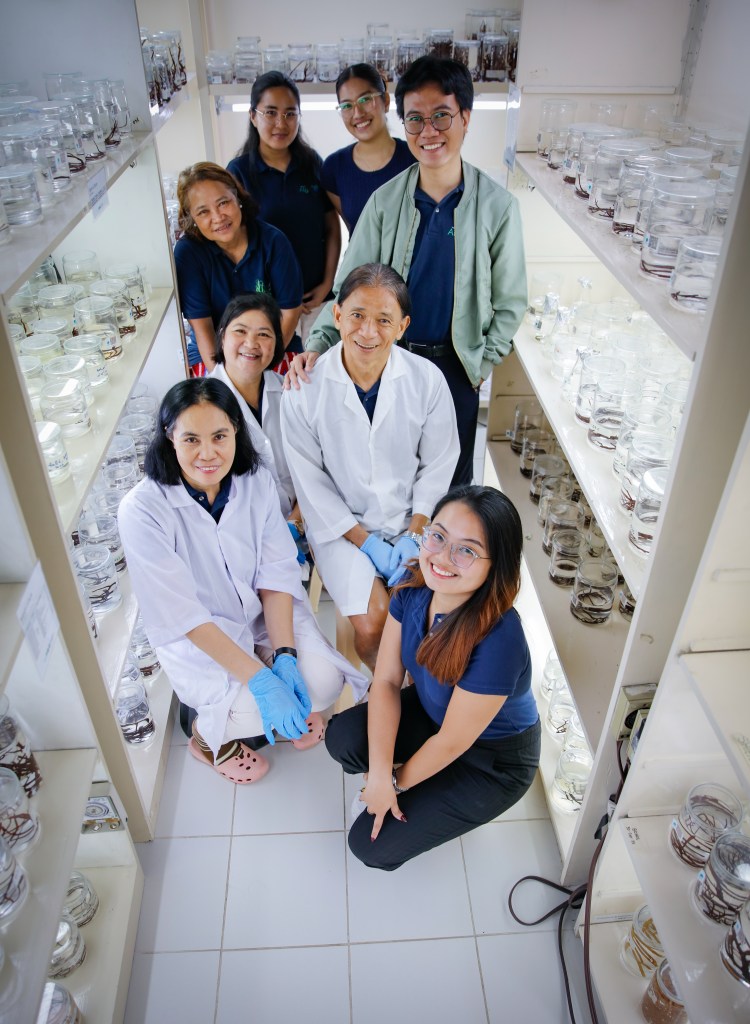
AlgaE Lab members (front to back) Steffanie Tagal, Eliza Belen, Dr. Michael Roleda, Apeth de Guzman, Ronel Aguilar, Helen Dayao, Jonalyn Catredilla, and Rhane Raca.
Photo by Misael Bacani, UP MPRO
The Best Fertilizer
Despite the positive results they have earned, the team realizes that more work needs to be done to help create a booming, catastrophe-proof industry. While the distribution of new strains is in full swing, the team knows that a larger budget will enable them to do more.
“Because we don’t have a sea-based nursery, we can only give out 5 kilos per strain,” Roleda explained. Moreover, their current setup means that while they can distribute seaweed to farms and collect data from there, they can’t really influence methods of planting and succeeding maintenance.
“Once they get out into the field, we can only hope that our collaborators are doing the right thing.”

Lourie Hinaloc inspecting a Bohol seaweed farm. Photo from the AlgaE Lab.
This is important because all the data that they collect suggest that the human factors – how seaweed farms are run, nourished, and maintained, together with climate change – are even greater contributors to lost productivity than the genetic diversity problem.
“That is why the next phase of our research is to increase the so-called ‘ecological breadth’ of our seaweed,” he explained. “For example, if a strain’s temperature tolerance is only from 28 to 30 degrees (Celsius), let’s find ways to make it up to 35 degrees, for example. Let’s make our seaweed more resilient to wider ranges of temperature and salinity.”

Red seaweed is sun-dried before storage and carrageenan extraction in Palawan. Photo from the AlgaE Lab.
All of this, Roleda hopes, will come with a greater capacity to get their lab’s findings through to seaweed farmers. Not to point fingers, but to present data that, he hopes, will increase interest in traditional farming practices over gimmicks that promote short-term gain.
“They say that the best nourishment for seaweed is your shadow. Meaning you have to be there daily, taking care of your crop. Since seaweed is in almost everything we eat, let’s take care of the natural environment where seaweed lives and, together, change how our country views its importance.”
