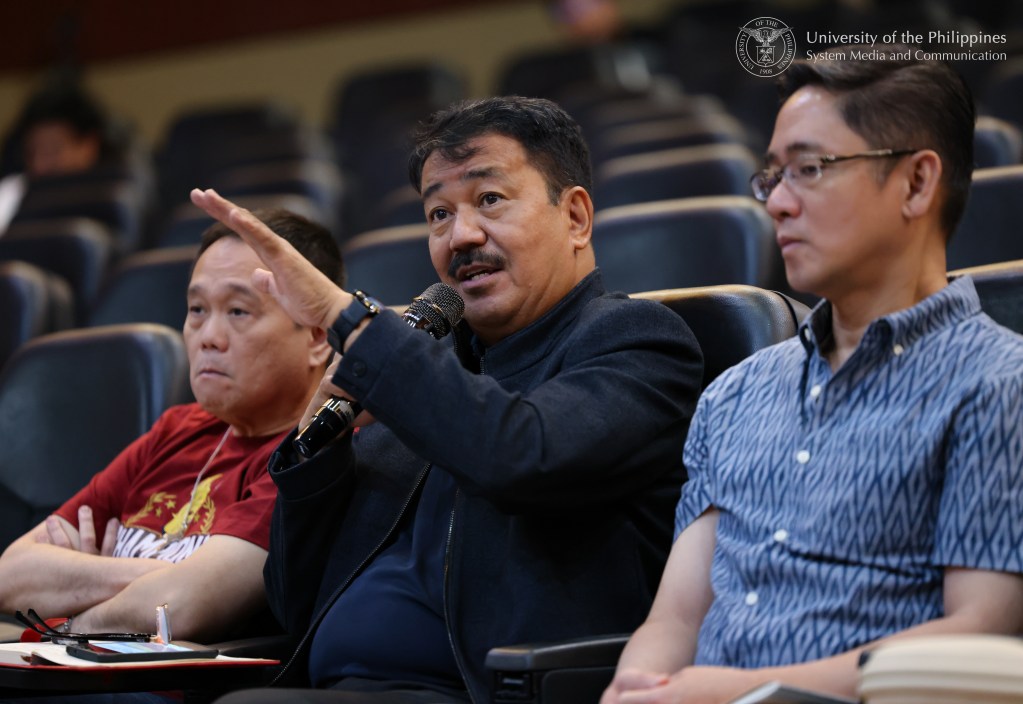
A panel of experts convened to assert that arts, ethics, and humanities are essential foundations for cultivating productive citizens. The discussion emphasized that general education equips students with the critical thinking and ethical discernment necessary to navigate a complex, changing world.
The event, Arts, Ethics and Humanities: GE in Higher Education, was organized by the University of the Philippines Center for Education and Development, under the Office of the Vice President for Academic Affairs. It was held June 10 at the Institute of Biology, UP Diliman and is the second panel discussion on GE, the first of which was held May 22.
The panel featured Dr. Jack Tsao, associate director and senior lecturer at the Common Core Office of University of Hong Kong; Dr. Edizon Fermin, chair of the Commission on Higher Education Technical Panels on GE, Teacher Education, and Graduate Teacher Education; and UP Diliman Professors Abdulmari “Toym” Imao Jr., Liza Ocampo, and Jose Wendell Capili.
Tsao, also a principal fellow at Advance HE, a UK-based organization promoting higher education excellence, stated that training young people for job skills and citizenship must not be treated as separate goals. “We need a large workforce with cognitive skills. … We want people who understand human needs, who can judge what’s worth doing, what’s going wrong, and when to push back.” He emphasized that now was not the time to reduce GE.
“Employability and citizenship are inextricably linked,” remarked Fermin, adding that education aims to produce a workforce that drives the nation to a desired future. He noted that the CHED is expanding its multi-layered consultations to gather more data and insights from stakeholders, who include parents, teachers, alumni, and professional organizations.
Imao Jr., who also heads the UP President’s Committee on Culture and the Arts, stressed the need to strengthen and harmonize — rather than homogenize — education at both the basic and higher levels, especially at this time. He pointed out that the country has over 100 diverse, indigenous cultures that should be part of a humanized education.
Ocampo focused on how GE should develop the human person as the core of employability and citizenship. She argued that students need sufficient time to learn ethical thinking and to make informed, individual choices. This is to ensure they evolve into principled citizens and employees. She teaches Ethics 1 under the UP System GE framework.
Capili illustrated how arts and humanities are tools for social mobility, helping students gain the agility to navigate unfamiliar power structures. He explained that GE protects graduates from technological obsolescence, and the humanities enable them to think systematically and handle uncertainty. He teaches English 13 under the UP System GE framework.
Assistant Vice President for Academic Affairs (Faculty Development) Ian Kendrich Fontanilla was panel moderator.