Control is one of the central principles underlying any feat of engineering. By harnessing and controlling the laws of nature, engineers not only shape the world to their will, they ensure that the products of their imagination behave predictably and for the greater good.
That beautiful idea certainly motivated Micah Angelo Bacani, an alumnus of the Electrical and Electronics Engineering Institute, University of the Philippines Diliman. As an undergraduate, he had already been fascinated by control systems, frameworks that ensure machines respond intelligently to input and adjust themselves towards a goal. Bacani dreamed of being a space engineer, applying his knowledge to help Filipinos make their mark in the great unknown.
There was only one problem: the world was locked down by the COVID-19 pandemic then, and Bacani, a senior, needed a project he could work on mostly remotely in order to graduate.
Fate, however, would intervene. Amidst the endless research possibilities a young electronics engineer could engage in, Bacani found his way to Dr. Manuel Ramos Jr.’s Robotics and Automation Laboratory. Under Ramos’ tutelage and mostly from home, Bacani would create the proof of concept in his bid for control system mastery: a low-cost, myoelectric hand orthosis prototype.
Orthoses are wearable devices that help stabilize and improve the movement of people with weakened muscles and joints. With them, a stroke or spinal cord injury patient can become a more active participant in their rehabilitation as orthoses can apply force to help them grip objects like mugs or pens.
It wasn’t yet the space engineering work he had initially envisioned, but Bacani’s award-winning work would prove that beyond manipulating machines, control systems could also help patients regain literal control of their health and dignity if developed properly.
Power of intent
Working in his makeshift home laboratory, Bacani had to overcome one big challenge working as a solitary electronics engineer. “My knowledge of mechanical engineering was not that good,” he admitted, hinting at the elaborate moving parts found in other orthoses and prostheses. Moving parts he might have been expected to make.
To sidestep this, however, he decided to take design tips from an earlier orthosis by Korean researchers Hyun-Joon Yoo and colleagues. Rather than use an elaborate glove-like contraption, that team used ring-like supports on a patient’s fingers connected to nylon strings, which in turn are pulled by a linear motor to induce grip.
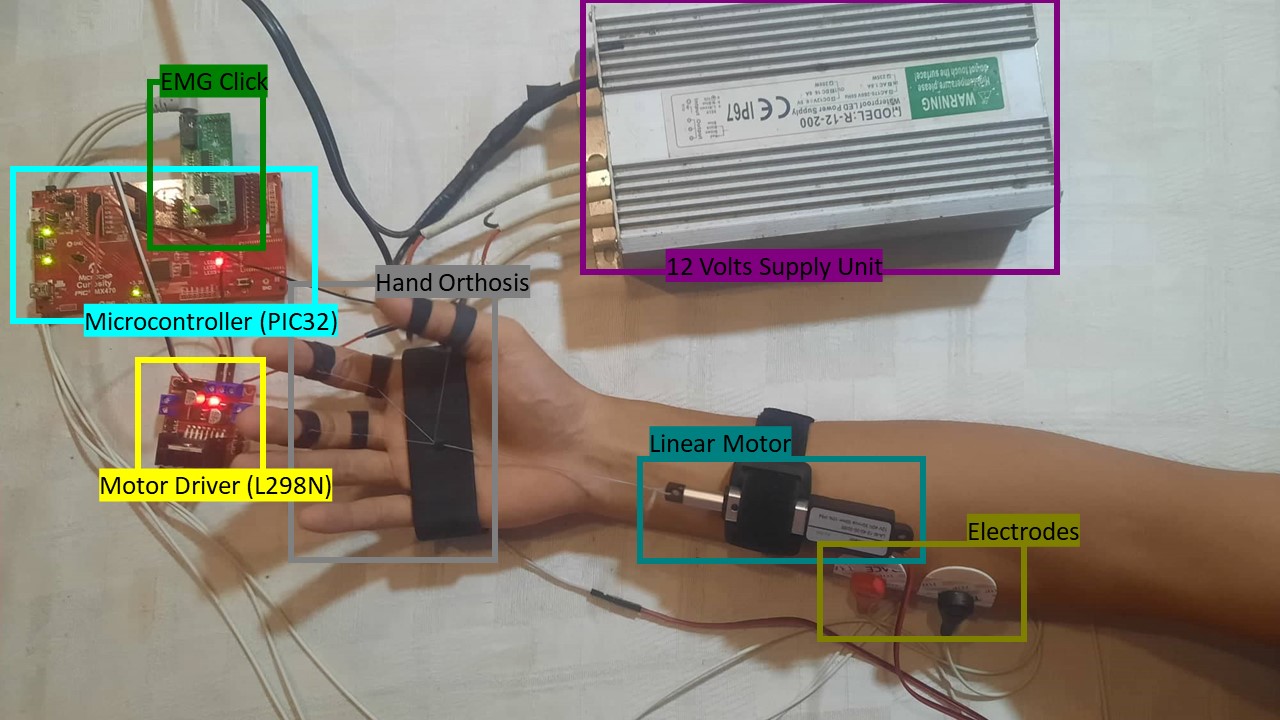
Bacani’s myoelectric hand orthosis at full grip (top left) and full release ( top right). An end-to-end labeling of Bacani’s entire hand orthosis setup (bottom), from the electrodes that sense muscle activity to the finger rings that open and close the hand. Photos from Micah Angelo Bacani.
More than this, however, Bacani’s prototype had one big bonus feature: force control.
In many low-cost orthoses, gripping works like a lightswitch. Sensors pick up electrical signals in the muscles, which in turn signal the device to apply a set amount of force to open or close the hand. In contrast, Bacani’s prototype works like a dimmer switch. Electrodes connected to a patient’s upper arm measure the magnitude of the electrical signals of muscle movements. These signals are sent to an EMG unit and are then digitally filtered, with a succeeding signal sent to the motor, which then applies proportionate force. That way, each movement feels intentional rather than automated. It is a machine that speaks in degrees, rather than in yes or no.
“The hope is it will eventually be used for rehabilitation,” Bacani said, talking about why this variability is important. Variable force matters because recovery is not just about restoring motion but regaining control. This also ties in to the fact that in rehabilitation, each case is different and items are most effective when customized for specific needs. That factor makes a lot of similar products expensive. Bacani, however, made it a point to make his innovation affordable through 3D-printing and low-cost materials.
“I think being low-cost is a value that is embodied by UP as a university,” he remarked. “We even see it in the way we try to make education accessible. So it’s a value we want to push.”
In space
After submitting his work, Bacani successfully graduated from the EEEI. With precious experience under his belt, he now leaves the improvement and day-to-day medical applications of his orthosis to future scholars. “The next steps would be to optimize and refine,” he said. “Like working on sensitivity, since the current device is very sensitive to body movements. Technology like that exists for sure, things like Apple Watches have a version of them. But the trick would be to integrate them in a low-cost way.”
And Bacani himself? He eventually achieved his goal of becoming a space engineer, eventually earning an MSc in Aeronautics and Space Engineering from the University of Surrey in the United Kingdom. Today he works at the Philippine Space Agency, applying his control systems knowledge to the upcoming Maya 7 cube satellite as the country aims to fully localize satellite construction. Bacani is working on attitude determination and control systems, which allow satellites to point where we want them to point based on feedback from their sensors. Not too different in essence from his orthosis work.
This time, however, he will be using magnets. “So, what we use are permanent magnets and magnetorquers,” he said. Based on input like the position of the sun, these magnets provide both passive stability and active control by aligning the satellite with Earth’s own magnetic field. Bacani and his team aim to launch Maya 7 by the third quarter of 2027.
“Intuitively, you might think that satellite engineering would be so far from robotics. But at its core it’s just microprocessors, microcontrollers, and sensors working together, talking with each other,” he said. “It’s all the same thing in different contexts.”
Read Bacani and Ramos’ published article here.
Cover photo by Tricia Mabale, UPS-MCO.