Since championing solar power research in the 1990s, Professor and Associate Dean for Public Engagement Rowaldo Del Mundo of the Electrical and Electronics Engineering Institute, University of the Philippines Diliman has pursued a twofold mission: helping secure reliable electricity for the country while finding ways to make power more affordable for ordinary Filipinos as head of the institute’s Power Systems Simulation Laboratory.
The latter issue has burdened local households for decades. In a 2015 paper, Del Mundo noted that Philippine electricity prices were comparable to those in Singapore — a far wealthier ASEAN nation — yet significantly exceeded rates in countries such as Indonesia and Vietnam. The result, he argued, was not only a heavier financial strain on families and a lower quality of life for ordinary Filipinos, it also weakened national competitiveness.
According to Del Mundo, the primary driver behind the country’s high electricity costs is not taxation or fuel prices alone, but structural problems introduced by the Electric Power Industry Reform Act of 2001, more commonly known as the EPIRA law.
“That law,” he explained, “allows generation companies, who own the power plants, to also supply electricity, which is the job of distribution utilities.”
“For example, Meralco is a distribution utility. They sell to consumers and provide electric service. But they also buy from themselves because they are also generators.”
Under the law, the generation sector is considered competitive, while the distribution sector is regulated. Distribution utilities are expected to procure affordable electricity on behalf of consumers. But according to Del Mundo, that incentive weakens when companies own both generation and distribution assets — a setup he describes as a “conflict of objective.”
“It turns out that there is a massive structural problem involving private distributors,” he said. “Because they can negotiate with themselves.”
With electricity prices effectively at the mercy of market giants, Del Mundo began searching for ways to restore competition to the system. Around 2010, he launched a training program at UP’s National Engineering Center to help smaller electric cooperatives — many of which lacked the economies of scale to negotiate favorable prices on their own — learn how to competitively procure electricity.
What emerged from these efforts was an innovative procurement model designed to stimulate competition and reduce electricity costs. Years later, a version of that same model would become the foundation for UP’s own energy plans.
The power of many
According to Del Mundo, one way smaller players can overcome their lack of bargaining power is by combining their demand into one large market attractive to suppliers — a strategy known as “power supply aggregation.”
Put simply, scattered electric cooperatives that were once too small to negotiate favorable rates could aggregate their demand into a single massive bloc capable of attracting serious competition from power generators through transparent bidding.
The model was first demonstrated in Mindanao, where Del Mundo helped electric cooperatives aggregate their demand into a 300-megawatt bloc. The effort reduced electricity prices from around P5 per kilowatt-hour to P4.09 per kilowatt-hour. Central Luzon cooperatives soon followed, eventually securing contracts at P3.70 per kilowatt-hour — an almost unheard-of reduction at the time.
Soon, cooperatives from across the country were seeking Del Mundo’s guidance. Northern Luzon followed, then the Visayas. Around the same time, a former student working as a legal officer at UP Los Baños reached out to him regarding a proposed agreement with Meralco.
At the time, Meralco wanted to enter UPLB as the campus’s distribution utility, directly metering and supplying individual buildings in a setup similar to UP Diliman’s. The arrangement promised improved reliability and streamlined management of the campus electrical system, and according to Del Mundo, the agreement was already close to being signed.
Del Mundo, however, urged university officials to reconsider.
Unlike UPD, UPLB operated as a single high-voltage customer. Accepting the proposal, he argued, would prevent the campus from taking advantage of the EPIRA law’s Retail Competition and Open Access provisions.
Under those provisions, UPLB qualified as a “contestable customer” — meaning it could legally choose and competitively procure its own electricity supplier instead of relying on the distribution utility’s default supply. Since generation charges account for roughly 50% to 60% of a typical electricity bill, Del Mundo believed competitive procurement could produce substantial savings.
Using this argument, Del Mundo and his colleagues convinced then UP President Alfredo Pascual to suspend the proposed Meralco agreement. Pascual later appointed Del Mundo to UPLB’s bids and awards committee, where he helped design a five-year procurement strategy that eventually saved the campus roughly P500 million from its P750 million electricity budget through competitive procurement and strategic participation in the Wholesale Electricity Spot Market.
For Del Mundo, however, the goal was never simply to advise industry from the sidelines. If competitive procurement and renewable integration could lower electricity costs for electric cooperatives and local governments, he believed the same principles should be tested within UP itself.
The breakthrough raised an important question: Could the same model work across the entire UP System?
The idea gained traction during the administration of former UP President Danilo Concepcion but was temporarily shelved after the war in Ukraine triggered global spikes in fuel and electricity prices. Under UP President Angelo Jimenez, however, the initiative has been revived — this time not only as a cost-saving measure, but as part of the university’s broader push toward sustainability and energy resilience.
Rewiring Diliman
One of the biggest challenges facing Del Mundo’s retail power aggregation initiative is that no two UP campuses share the same electrical setup.
Unlike UPLB, electricity in UPD does not enter through a single high-voltage connection. Instead, Meralco directly supplies and meters each building individually, treating each as a separate low-voltage customer. As a result, the campus cannot automatically operate as one large “contestable customer” under the EPIRA framework.
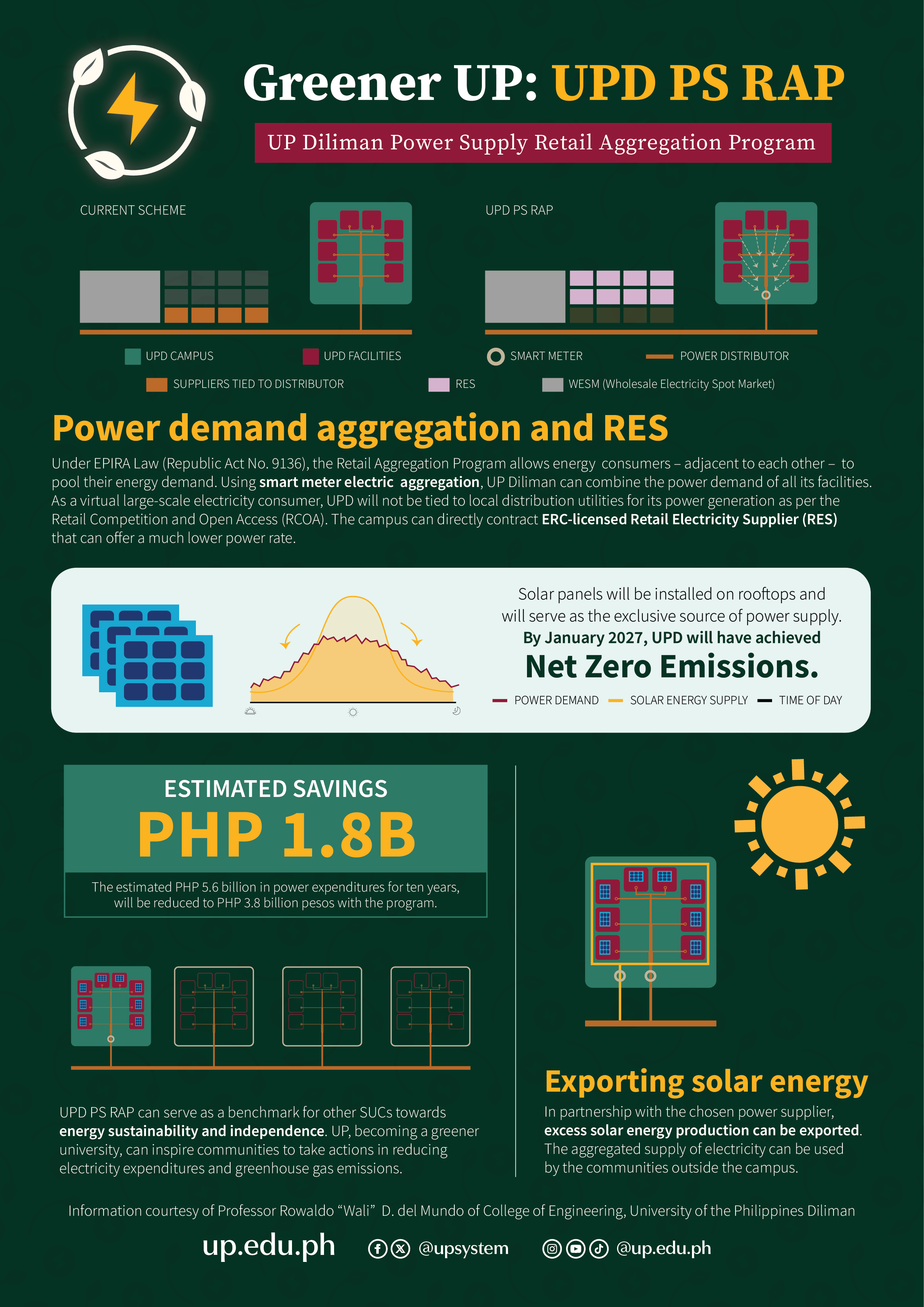
To address this, Del Mundo’s team proposed a retail aggregation strategy tailored specifically for Diliman. By replacing conventional meters with synchronized “smart meters,” the university could effectively treat the electricity demand of individual buildings as a single aggregated customer.
Once aggregated, UPD would be able to enter the RCOA market and competitively select its own retail electricity supplier rather than rely solely on Meralco’s default generation supply.
The benefits, Del Mundo said, extend far beyond lower electricity costs.
Under the revised proposal, UP campuses such as Diliman would transition toward net-zero emissions by sourcing electricity entirely from renewable energy. “For the whole program,” Del Mundo said, “we will be procuring from a supplier licensed by the Energy Regulatory Commission.”
That supplier, he added, would also be required to install solar panels across the rooftops of more than 160 university buildings, transforming unused roof space into a distributed power-generation network.
While UPD currently requires only about 14 megawatts of power annually, Del Mundo’s team estimates that the campus rooftops could generate up to 28 megawatts of solar energy. Excess power could then be sold back to the grid, with the university receiving a share of the revenues.
However, the long-term vision goes far beyond even savings.
Under the proposed arrangement, UPD could save an estimated P1.8 billion over 10 years, even before accounting for revenues from excess solar power. After the contract period, ownership of the solar facilities would be transferred to the university.
“That means after the turnover, electricity in UP will be free,” Del Mundo said. “We don’t have to pay anything except maintenance costs, which are less than one percent of what we will save.”
Beyond dramatically reducing electricity costs, the system would also help insulate the university from volatile fossil fuel prices and geopolitical crises that can sharply drive up the cost of oil and coal. “In total, we will have P6.8 billion in total savings if you add ten years. And once the solar panels are here, within just a year, we can declare net-zero emissions for the university.”
The project represents more than an infrastructure upgrade for Del Mundo. It is an attempt to show how local universities can use engineering, policy, and public service together to confront the country’s persistent and seemingly intractable electricity cost problem.
People Empowerment
After working out the aggregation and renewable energy strategy for UPD, Del Mundo now zips across the country to tailor-fit his approach to all of UP’s campuses — each one unique in its size, energy requirements, and context.
UP Mindanao, for instance, has neither the number of buildings of UPD nor the land area of UPLB. “Therefore, I told Chancellor [Lyre] Murao, we can put solar panels on your walkways. In those places without walkways, we can put solar panels, but let’s elevate the mounting.”
“The chancellor was very happy!” he noted.
In addition, UPMin has an open area of around 20 hectares. “We can also build solar panels there, not just for us, but connected to the grid, which sells electricity,” Del Mundo said, “In the same way, we will be building 400 megawatts of wind power in our Quezon Province land grant.”
While worthy innovations like this should naturally start in UP, Del Mundo believes that they definitely should not end here. He adds that any group of individuals, large and determined enough, can choose to aggregate in the same way UPD is planning to and chart their own course for electrical supply. In fact, he has been preparing aggregation templates that other interested organizations can follow.
“If you can convince all your neighbors to aggregate, then you can do what UP Diliman has been demanding,” he said. “We are demonstrating in Diliman that its buildings are just technically neighbors that decided to aggregate.”
“We are empowering people,” Del Mundo concluded. “This is people empowerment.”
Cover photo and animation by Rod Villafuerte Jr., UPS-MCO