


Photo by Kevin Roque, UPS-MCO.
“The oceans are full of plastic because the oceans cannot vote.”
University of the Philippines President Angelo Jimenez told the second batch of Lawod fellows of the Kalalawdan Fellowship Program during their courtesy visit, Aug. 3 at the Executive House, UP Diliman.
“For science to really make an impact, we have to develop a political constituency,” he declared. “Political constituencies are people who vote. Rivers do not clean themselves.”

Photo by Kevin Roque, UPS-MCO.

Photo by Kevin Roque, UPS-MCO.
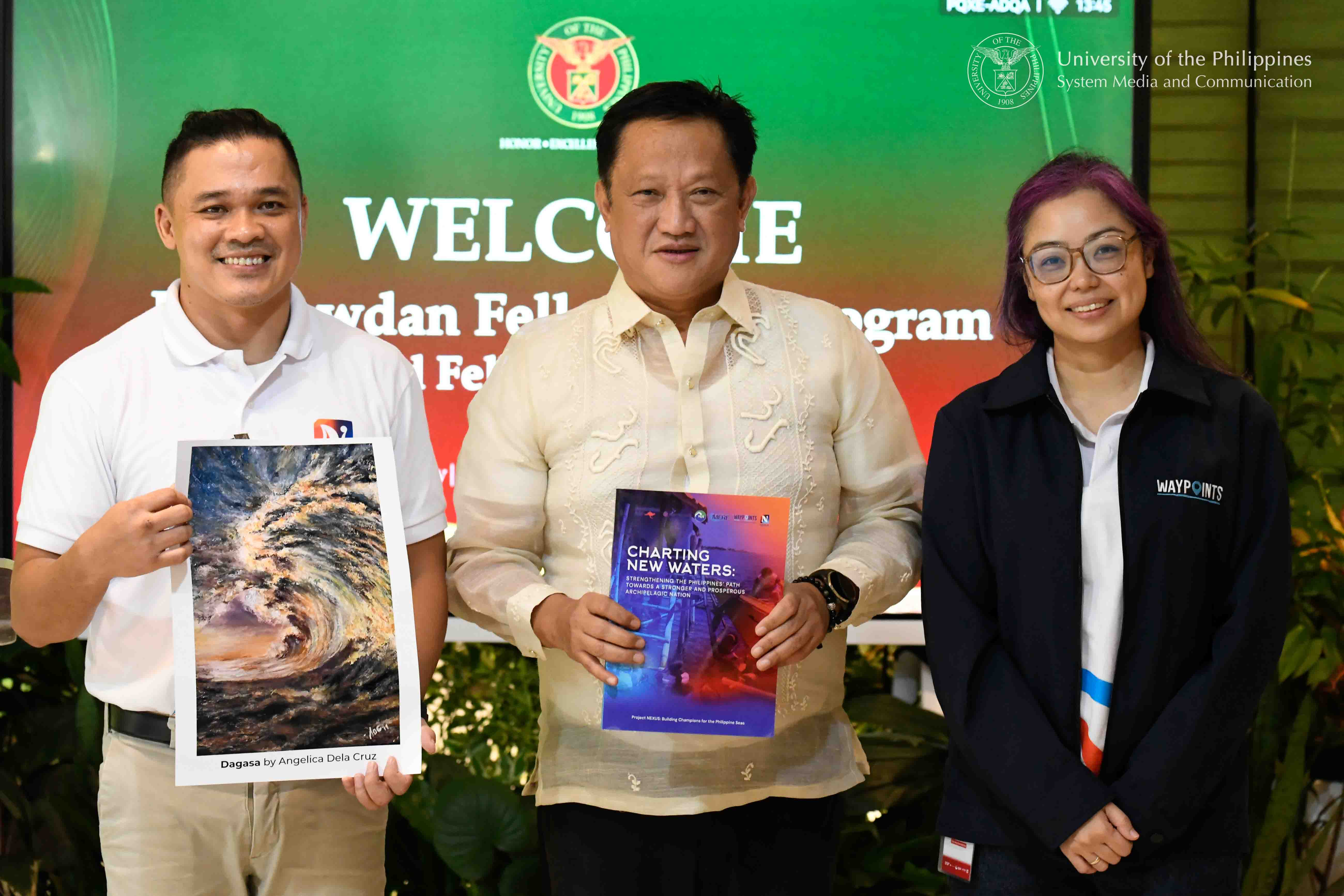
Photo by Kevin Roque, UPS-MCO.
In his presentation, Onda explained that “lawod” or “kalalawdan” was derived from the Visayan and Waray term, which refers to the sea or ocean. He said that Filipinos seem to have forgotten that the Philippines is a maritime country. “We see the waters to be separating us rather than connecting us.”
“If we want to strengthen the identity of the Philippines as a maritime ecologic country, we need to push for reforms in all sectors, including policies,” Onda added.
The Kalalawdan Fellowship Program is part of Project NEXUS, led by Professor Deo Florence Onda. It was launched in 2024 as an eight-month training program. Supported by the Australian government, implemented by The Asia Foundation, and in partnership with MSI and Marine Environment and Resources Foundation Incorporated, the second iteration, Project NEXUS 2.0, builds upon the gains of the first group and aims to advance science-informed maritime governance and promote regional cooperation in marine scientific research. Project NEXUS 2.0 is a feature of the larger project, Waypoints: Navigating Civil Maritime Security Reform, which is funded by a grant from the Australian Department of Foreign Affairs and Trade, implemented by TAF, in partnership with Amador Research Services.
Photo by Kevin Roque, UPS-MCO.