


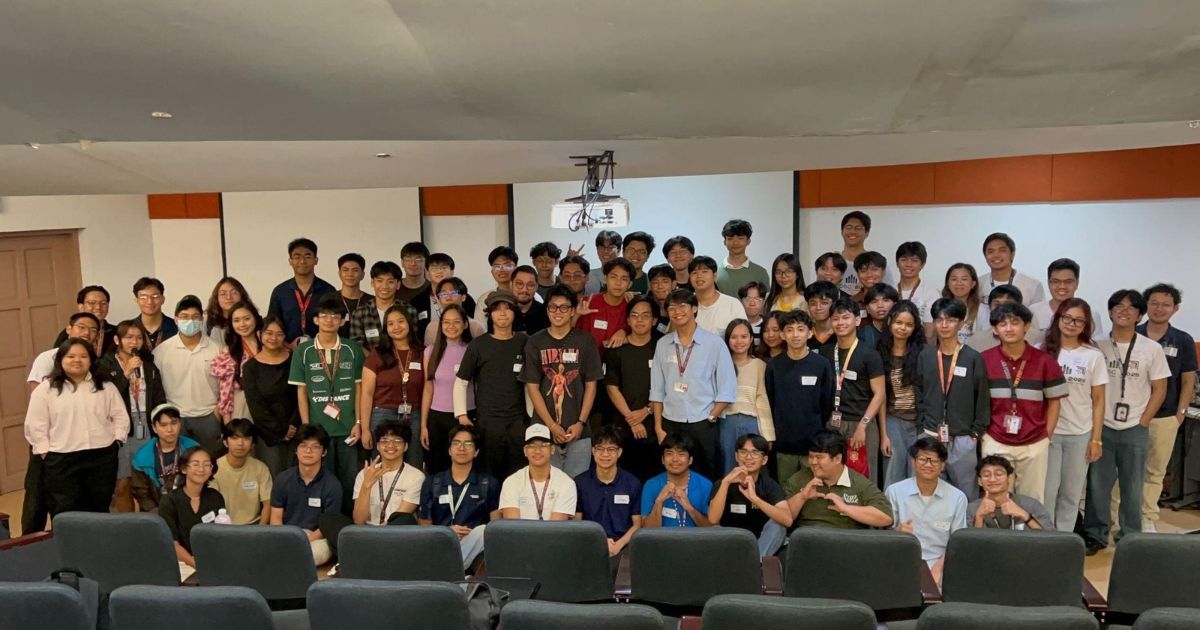
QUEZON CITY (Nov. 5, 2026) – The University of the Philippines Data Science Society, together with the UP Intelligent Systems Center, conducted the Philippine Junior Data Science Challenge 2026 Project Development Workshop, Oct. 17 at the College of Science Auditorium, UP Diliman. Themed, Trace the Pattern, Target the Cure: Advancing Public Health with Data Science, the workshop brought together healthcare and technology experts to teach participants how to use data-driven methods to solve local public health issues.
Dr. Paulyn Jean Claro, associate professor at UP Manila’s College of Public Health, opened the workshop with a real-world case study on addressing decreasing vaccination coverage and unvaccinated children in the Philippines. By looking into the behavioral and social drivers of vaccination and pairing these with routine records from health institutions, she was able to reveal insights on the impact of caregiver age, the prevalence of incomplete vaccine records among children, and the importance of trust in healthcare workers and information, which could not have been possible by analyzing existing data alone. Claro pointed out, “Administrative data fails to reveal specific individual issues that may exist at a more granular level.”
Workshops were then facilitated by Uriel Alonso, senior cloud applications specialist at Apper AI Solutions, and UPD Assistant Professor Philip Christian Zuñiga of the Department of Computer Science.
Alonso illustrated how to turn broad public health issues into feasible, testable data science questions. She highlighted that data scientists should understand their project’s scope, data, and method, or the Three Feasibility Levers, and outlined six guide questions to check for feasibility. Participants were then given a chance to apply the six-question guide to one of five public health projects of their choice. “The goal isn’t to build the biggest thing you can imagine. It’s to find the most useful question you can answer with the evidence, time, and skills you actually have,” Alonso explained.
Zuñiga discussed data principles for decision-making among public health institutions. He outlined that data should be democratic, inclusive, and not only accurate, but also depend on “completeness, consistency, validity, uniqueness, integrity, and provenance.” He emphasized the importance of representing marginalized communities in datasets, as data collection systems may exclude these vulnerable populations. “If some people are missing from the data, they may also be missing from the decision,” Zuñiga cautioned.
To put these principles into practice, groups were provided with datasets and assigned audiences, then tasked with presenting the data to their assigned stakeholder.
The Project Development Workshop is an effort to support participants in coming up with data science projects for this year’s PJDSC competition. Following this workshop, a culminating event will be held in November 2026. The full livestream of the event may be found on the official PJDSC Facebook page.
###
The UP Data Science Society is an organization that provides a safe community to explore and dive deep into data science through workshops and training open to students from different fields and expertise. Its co-presenter, UP ISC, is a research center working across artificial intelligence, data science, complexity science, and related fields to address problems of public and societal importance.