A UP microbiologist found antibiotic resistance genes in Laguna Lake. Now what?

| Written by Andre DP Encarnacion

Back when she was a student, Dr. Pierangeli Vital, head of the UP Natural Sciences Research Institute’s Biological Research and Services Laboratory and a Gawad Pangulo for Natatanging REPS, always wanted to go to Korea. So, when the opportunity to pursue a sandwich PhD program at the Gwangju Institute of Science and Technology arose, mentors, including Philippine Genome Center executive director, Dr. Windell Rivera, encouraged her to take it. 


“That’s why I tried,” Vital remembers. “And luckily, I got accepted.”


At GIST, Vital studied with microbiologist Dr. Kenneth Widmer, who specializes in food safety and environmental microbiology. Widmer gave the young Vital opportunities to collect samples not only from the Philippines but also from other Southeast Asian countries, including Vietnam, to study microbial contamination. It was during these trips to investigate surface waters such as lakes and rivers that she came to a sobering realization. 


“In terms of levels of contamination,” she said, “we are at par with other Southeast Asian countries. Hindi tayo nagpapahuli.”


Upon returning home, Vital continued applying what she had learned, becoming a respected environmental microbiologist with a knack for using science to make everything from agricultural produce to urban farms safer for ordinary Filipinos.


Still, the issue of surface water contamination lingered. Years later, support from the National Academy of Science and Technology’s Outstanding Young Scientist program enabled Vital and her team to investigate the extent of microbial contamination in the country’s largest inland body of water: Laguna Lake.

Dr. Pierangeli Vital examines algae samples at NSRI’s Biological Research and Services Laboratory. Photo by Misael Bacani, UPS-MCO.

Lab-on-a-chip

One of the complications of studying microorganisms is the “micro” part of microbiology itself. To study contamination, scientists like Vital must monitor organisms invisible to the naked eye.  So, how did the team do it?


While bacteria can be cultured individually in a laboratory, an ordinary freshwater ecosystem contains countless microorganisms interacting simultaneously. That challenge is compounded by the sheer scale of Laguna Lake — a 950-square-kilometer body of water where people fish, farm, commute, and live. 


The researchers knew from the start that traditional methods could reveal only part of the story. Their goal was to understand not only the lake’s microbial community but also the antibiotic resistance genes those communities carry. To do that, they turned to a technique known as nanopore sequencing. 

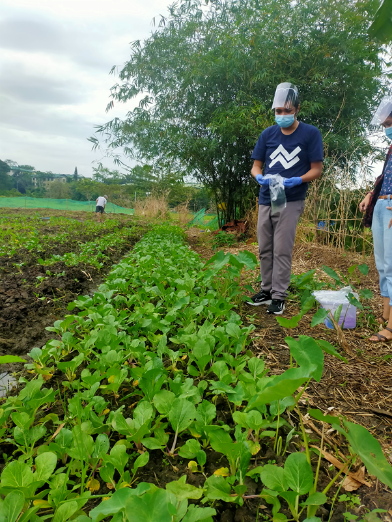
Members of BRSL studying contamination in the field. Photos from UP Diliman NSRI-BRSL.

Unlike traditional culture techniques — or targeted tools such as RT-PCR, which excel at detecting specific microorganisms or genetic markers — the researchers needed a method capable of making sense of entire microbial communities made up of countless species and millions of DNA fragments. Oxford Nanopore sequencing, a portable lab-on-a-chip device, can analyze virtually all of the DNA contained in a water sample. Combined with bioinformatics software, it enables scientists to identify the microorganisms present while simultaneously detecting many of the genes carried within the sampled DNA, including antimicrobial resistance genes. 


The resulting DNA sequences were then compared with international reference databases using specialized software. It was here that Vital and her colleagues uncovered what they had set out to find: the bacterial groups inhabiting Laguna Lake and the antimicrobial resistance genes associated with resistance to different classes of antibiotics. 

A community–and a warning

Much like what they observed in an earlier  meta-analysis of surface water systems around the world, Vital and her colleagues found a rich and diverse microbial community thriving in Laguna Lake. The community was dominated by bacterial groups commonly found in freshwater environments, including Proteobacteria, Actinobacteria, and Firmicutes


It is important to note that most of these organisms are neither unusual nor harmful. In fact, members of Actinobacteria have yielded many of the antibiotics used in modern medicine. The researchers also detected genera such as Escherichia, Salmonella, Acinetobacter, and Staphylococcus — names familiar not because every strain causes disease, but because some members are associated with foodborne illness, hospital-acquired infections, or the ability to acquire antibiotic resistance. 


For Vital, however, the true revelation was not so much in the bacteria themselves, but what they found in their genes. 

Dr. Pierangeli Vital heads BRSL, a laboratory aiming to be a leader in biological research and technical services in the Philippines and in the world. Photo by Misael Bacani, UPS-MCO.

The study identified numerous antimicrobial resistance genes or ARGs, including genes associated with resistance to several important classes of antibiotics such as beta-lactams, aminoglycosides, macrolides, tetracyclines, and sulfonamides. Particularly noteworthy was the abundance of multidrug resistance genes, which are associated with mechanisms that can allow bacteria to withstand multiple classes of antibiotics rather than just one. 


Vital insists that these findings do not constitute an immediate public health emergency. Merely detecting resistance genes in a body of water does not mean people will automatically be infected with untreatable bacteria or that fish from the lake are unsafe by default. What the findings do reveal, however, is the biological potential for antibiotic resistance long before it becomes a larger clinical or public health problem.

Watchful eye

Studies like Vital’s underscore the real challenge: improving the country’s capacity to respond to potential threats before they become national emergencies. 


Thankfully, serious work is already underway. Vital noted that the government, through the Laguna Lake Development Authority, routinely monitors water quality in Laguna Lake, including culture-based testing for microbial indicators. Her team’s nanopore study complements these efforts by providing another layer of information — the antimicrobial resistance genes circulating within the lake’s microbial community. 

UP Gawad Pangulo Natatanging REPS Awardee and microbiologist, Dr. Pierangeli Vital in her element. Photo by Misael Bacani, UPS-MCO.

The findings also highlight the importance of sustained collaboration between academia and government in developing science-based microbiological criteria and other technical guidance that inform national food safety standards — initiatives to which Vital and her colleagues actively contribute. Developed through the combined expertise of scientists, policymakers, regulators, and other stakeholders, these standards are among the strongest examples of how scientific evidence can be translated into practical public policy. 


“If we would strictly follow that,” she said, referring to the Philippine National Standards, “I would believe that we can really lessen, or even prevent microbial contamination.” 


Meanwhile, Vital and the BRSL continue developing new testing kits that could eventually be used even outside research laboratories. Yet many questions remain, both scientifically and in terms of policy. Inspired by mentors such as Rivera and UP Los Baños Professor Emeritus Milagrosa Martinez-Goss, Vital hopes more young people will find a part of the problem worth making their own — whether in science, governance, or even as informed consumers. 


“For me, everyone has a role in food safety and in environmental microbiology,” Vital said. “So, yes, you can join and get involved. There is so much left to do to help the country.”

Readers interested in the standards indicated above can explore the work of the Bureau of Agriculture and Fisheries Standards (BAFS), which develops science-based national standards in partnership with experts from universities, government agencies, and industry. 

Cover photo by Tricia Mabale, UPS-MCO.