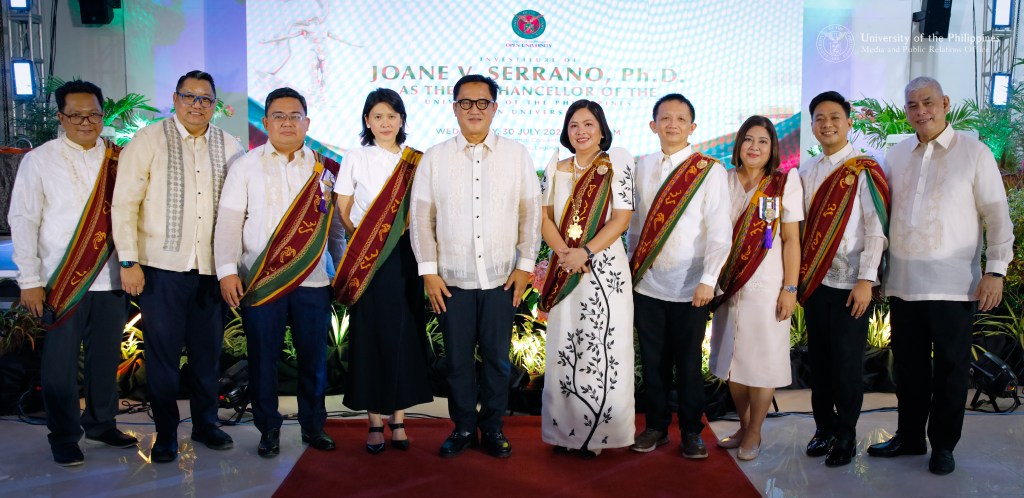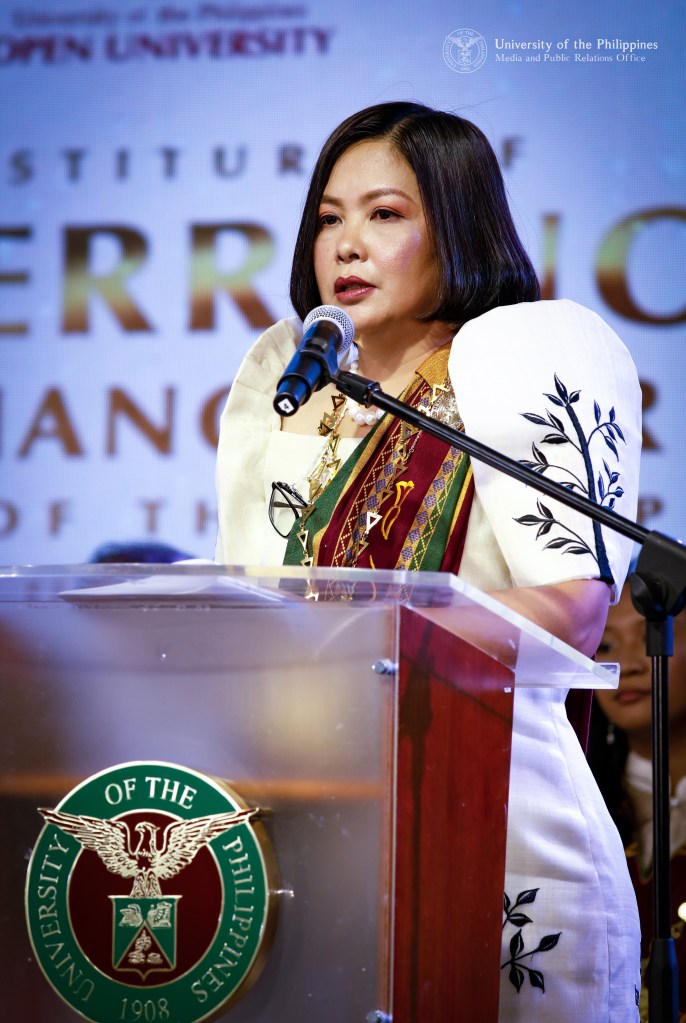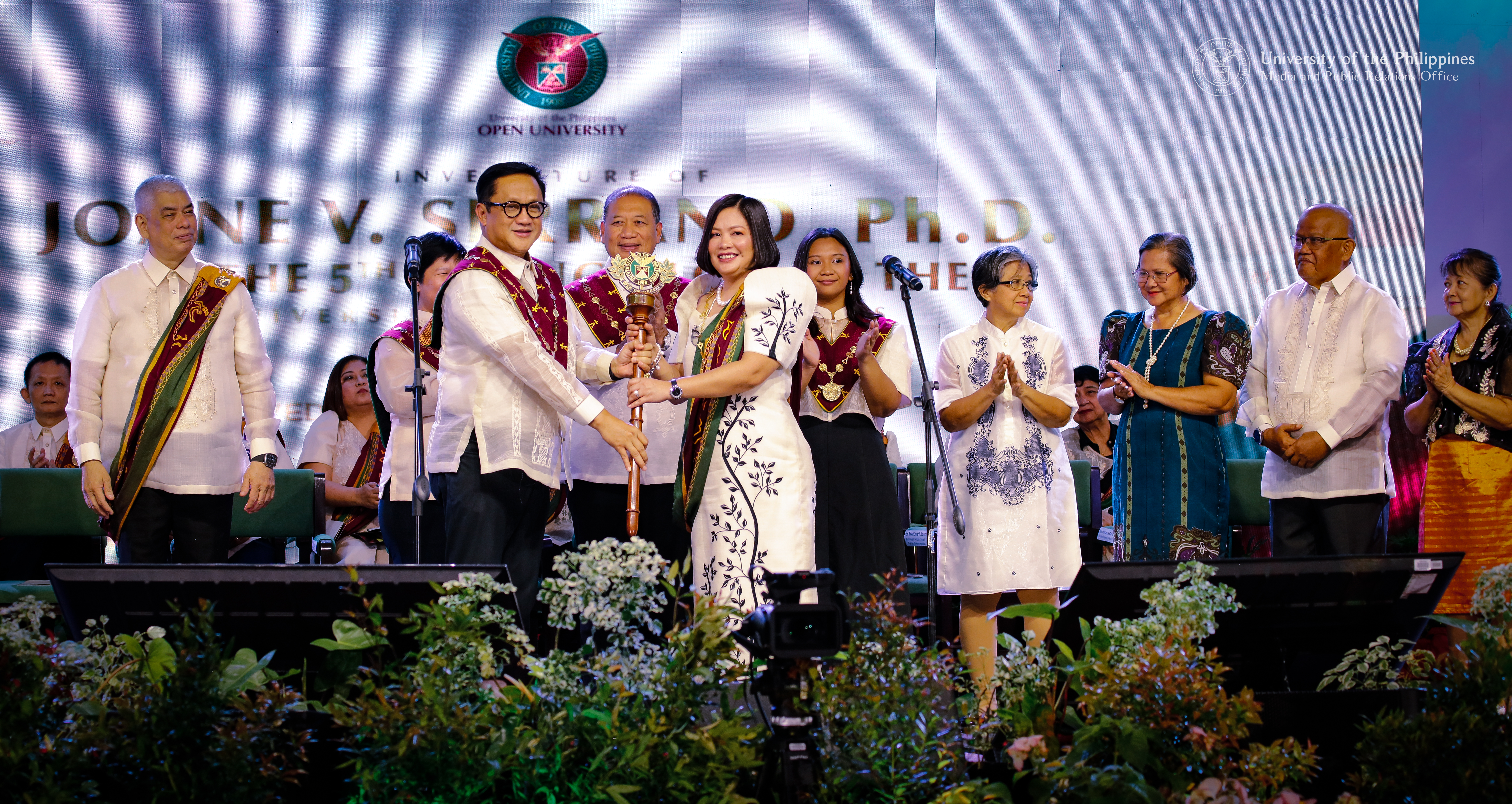
“We were built for the underserved, the geographically distant, the working Filipinos, the OFWs, the second-chance learners, those balancing multiple roles, those who couldn’t always be physically present but whose right to UP education remains just as valid [and] urgent,” declared Dr. Joane Vermudo Serrano, fifth chancellor of the University of the Philippines Open University, in her investiture speech on July 30 at the UPOU Headquarters, Los Baños, Laguna.
Further elaborating on UPOU’s identity and character, she said, “We led with openness before the world called for it. We championed digital learning before it became a necessity. We practiced inclusion before it was written into strategic plans and policies.”
Serrano’s statements were delivered with the confidence and authority of someone who has been with UPOU since 1995, when the constituent university was only eight months old. She was there for the growing pains — receiving criticism of distance education, bombarded with questions of legitimacy. But Serrano also experienced what it meant to open doors “for those who never imagined that a UP education could be within reach.” Almost 30 years with UPOU has shaped her conviction: “Education, when done right, transforms lives.”

‘Guiding commitments’
Four months into her term, Serrano has begun leading with her four interwoven “guiding commitments,” which are: UPOU as a learning university, a healthy university, a sustainable and resilient university, and an intrapreneurial university.
UPOU should be a place where “learning is not confined to classrooms or credentials, but embraced as a way of life by all of us,” she said, “where we are never too proud to unlearn and re-learn.”
A healthy university, she explained, is one where “well-being is not an afterthought, but a shared responsibility … and where psychological safety, work-life harmony, and compassion are woven into our systems and spaces.”
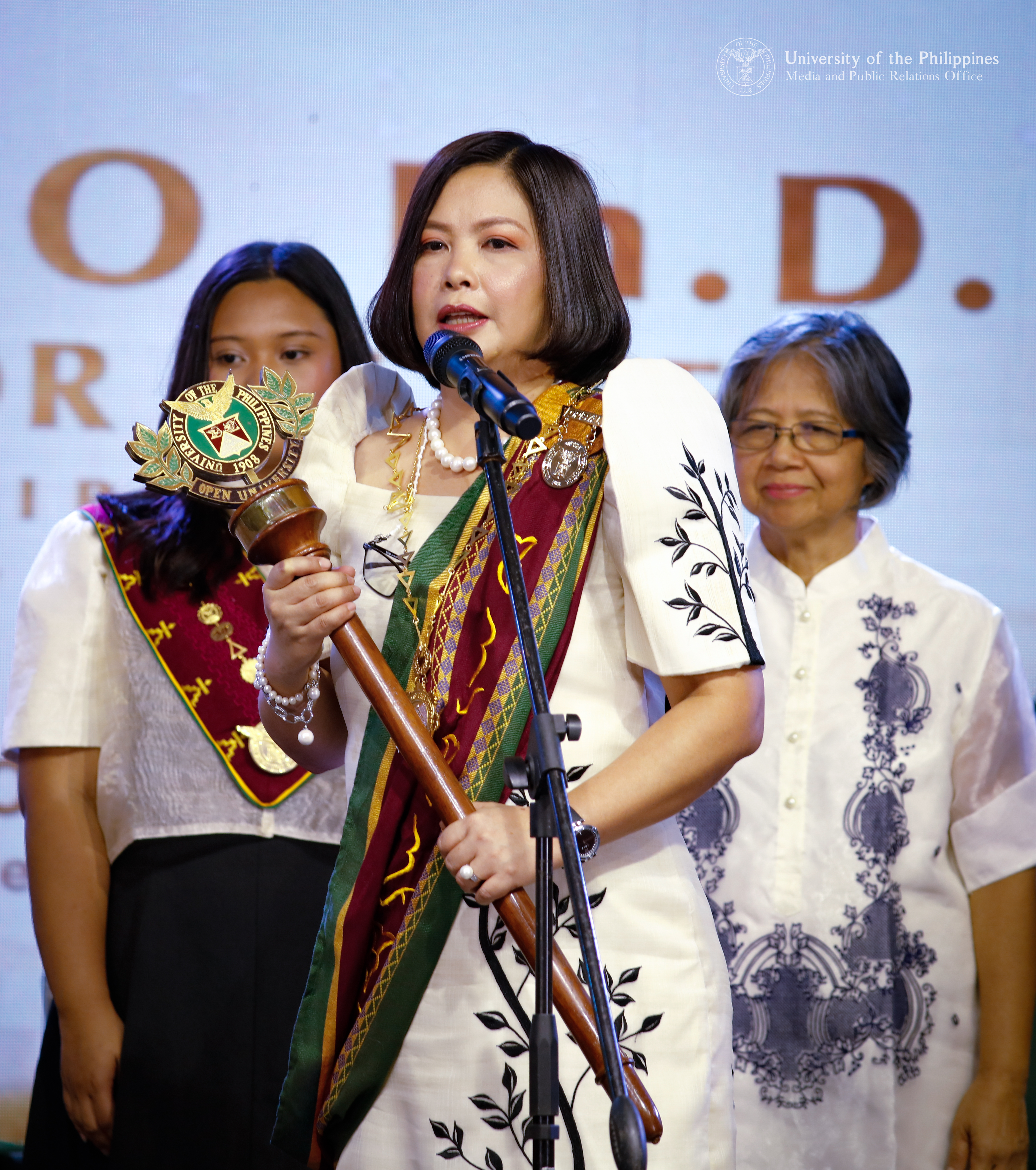
Sustainability and resilience entail efficiency, ecological impact, ethical integrity, and social equity. Serrano encourages an atmosphere where UPOU faculty, researchers, staff, students, and alumni “teach, do research, and serve in ways that restore, regenerate, and rethink what is possible.”
Finally, UPOU as an intrapreneurial university, according to Serrano, means a UPOU “where we act not only as scholars, but as solution-builders. Where innovation is grounded in purpose and responsiveness. Where we cultivate ideas that challenge the status quo, address persistent gaps, and form partnerships that uplift and empower.”
Lessons from her predecessors
Serrano began her UPOU career as a university research associate, a little over a year after graduating from UP Los Baños with a BS Development Communication degree. Dr. Ma. Cristina Padolina was the chancellor then, UPOU’s first. After two terms, she was succeeded by Dr. Felix Librero (†), who served two terms as well. Serrano moved up from being an associate to a university researcher during his term.
Dr. Grace Javier Alfonso was UPOU’s third chancellor and she served for three terms. It was during her time that Serrano went into teaching, from senior lecturer to assistant then associate professor. She became a full professor in 2019, during the second of Dr. Melinda Bandalaria’s three-term chancellorship. Serrano was also the director of the then Information Office (now Office of Public Affairs) from 2016 to 2022, and simultaneously as director of the Multimedia Center from 2016 to 2018 and the Office of Gender Concerns from 2020 to 2022.
“I am reminded of the challenging journeys that my predecessors took over the last 30 years … difficult, rough, and uncertain — marked by resistance, skepticism, and the challenge of pioneering new ways to learn,” Serrano led before sharing the collective lessons she learned from UPOU’s previous chancellors.

“Education, when done right, transforms lives.”
First, open and distance education as a form of social justice. “I believe that UP must do more than uphold academic excellence — it must ensure that excellence is accessible.” She asserted that the university must serve all Filipinos who deserve a UP education, “not just top performers or the well-resourced” and that “opening the doors of UP is not a gesture of generosity, it is a commitment to justice.”
Second, technology is a tool, not the goal. It is about what technology can enable. “Technology matters only if it helps us serve better, teach more inclusively, and plant the seeds of innovation where they are needed most,” Serrano emphasized.

Third, public service is the soul of UPOU’s mission, “felt not only in credentials and certificates, but in everyday actions, quiet impacts, and ripples of change.” She added that public service is at UPOU’s core, not in its periphery.
Fourth, “education is lifelong and life-wide” — beyond the brick and mortar, not beginning and ending with a diploma. “At UPOU, anyone, anywhere, at any point in their life can be a learner,” Serrano said. “[We] offer doorways to transformation.”

Thoughts on leadership
Speaking not just on her role as UPOU’s fifth chancellor, but on UPOU’s leadership and how its community can further contribute to that leadership, Serrano reminded them that leadership “begins with questions, not answers” and that it is not about “waiting until we are ready,” but stepping up without hesitation. “We are not here to conform; we are here to transform.”
Further, she asked them to remain “anchored on purpose” and to keep close the UPOU values of “scholarship, academic excellence, academic freedom, humanism, social responsibility, and service to the nation.” Serrano acknowledged shared leadership and told the UPOU community, “This moment is not mine. It belongs to all of us.”
Serrano, who earned her graduate degrees, Master of Management in 2000 and PhD in Development Communication, minor in Educational Management in 2013, from UPLB, will serve a three-year term until February 2028.