
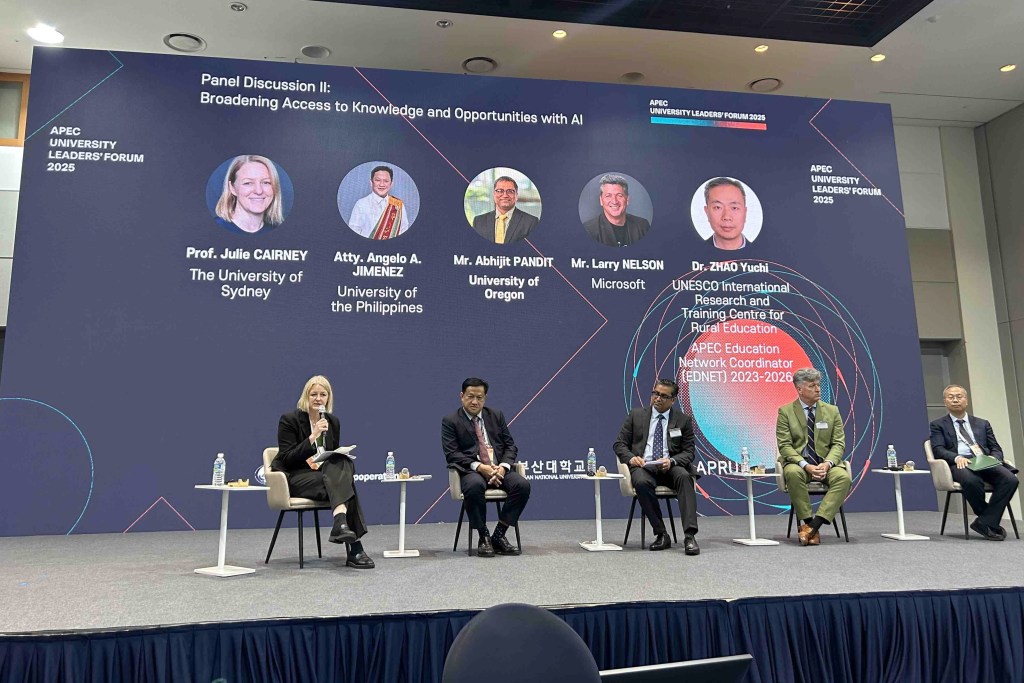
Opening Remarks of University of the Philippines (UP) President Angelo Jimenez
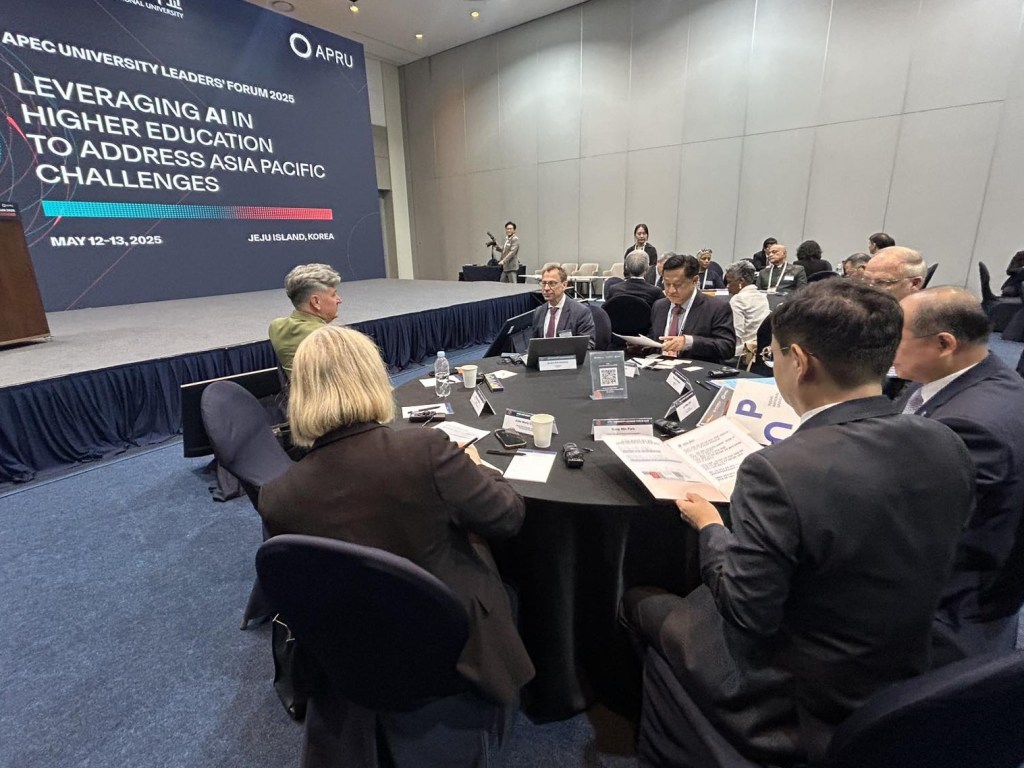
for the APEC University Leaders’ Forum 2025: Leveraging AI in Higher Education to address Asia Pacific challenges
May 13, 2025, Jeju Island, Korea
 Artificial Intelligence is not new. But in the past few years, AI technology has evolved at an unprecedented pace, with the exponential growth of generative AI, agentic AI, and a multitude of ground-breaking applications. AI has become a driving force of innovation like never before — disrupting our daily lives and transforming professions and industries, including the field of education.
Universities of today: Shaped AI; shaped by AI
As fertile ground for research and innovation, universities possess the resources and expertise to leverage AI and promote its application. In fact, much of the foundational work in AI was developed in universities. But universities are not only producers of AI technology and use cases; we are also consumers in various capacities. To stay relevant and enhance the quality of education, universities must embrace the potential of AI in all areas of activity. AI is becoming increasingly embedded in education, enabling personalized learning experiences that adapt to each student’s unique needs. It also improves learning outcomes.
In the University of the Philippines (UP), we conducted a study on the impact of AI use on student learning, including their confidence in mathematics. We found that AI can enhance student engagement and, consequently, increase confidence in mathematics. The study found that although the students have comparable baseline knowledge, results showed a marked difference: the group that used AI achieved significantly higher scores than the group that did not, suggesting positive impact of AI intervention on learning outcomes. Perhaps AI can super-charge learning and fill gaps in ways we did not think possible in the past.
Duality of AI: AI supporting learning and learning supporting AI
According to the 2024 Global AI Student Survey involving more than 3800 students from 16 countries, 86% use AI in their studies, with 24% using it daily and 54% at least weekly. While AI supports student learning, there must also be support for learning about AI and related technologies. In the same survey, it was found that 73% of students expect universities to provide training for both faculty and students on the effective use of AI tools, and 72% expect universities to offer more courses on AI literacy. While students expect and prefer AI integration in universities, 80% say that current implementations fall short of their expectations.
In the Philippines, AI-powered tool adoption, particularly generative AI, is at approximately 48–49% nationwide, according to a study conducted by Truelogic DX. Usage among the current generation reached 52% from May-June 2024 alone, often extending beyond academic purposes. Thus, AI is not merely a tool; it represents comprehensive skills and knowledge that should be integrated into the entire educational and life experience of the user.
Advancing AI literacy for greater inclusion
UP has made it a priority to advance AI literacy through innovative approaches. The UP Open University currently offers Massive Open Online Courses or MOOCs on how AI can be integrated into education and enhance educational experiences and learning outcomes. These MOOCs will run from May to July this year and are designed to reach learners worldwide, whatever the background. UP also offers the country’s first PhD program on AI through the MEngg-PhD Straight Program Doctor of Philosophy in Artificial Intelligence. This makes AI education accessible to more students by avoiding the additional time and expenses associated with a graduate program. UP Cebu, another constituent university of UP, plans to offer in the next academic year a predominantly online PhD in AI which does not require a master’s degree. This initiative will open new pathways by removing barriers to advanced study particularly for the underserved and non-traditional backgrounds. As the national university, it is vital for UP to serve the broader interests of society.
AI innovations: Knowledge-sharing and potential collaboration
At UP, our AI research has practical applications for the wider community. Some examples include using AI to study plant habitats and reproduction, improving microbial food safety in the ASEAN region, developing explainable machine learning tools for breast cancer diagnosis, and using a combined deep learning method for classifying brain tumors.
Last year, UP organized a national conference on AI-powered research and innovation to highlight solutions in four key sectors: Food, Agriculture, Livestock, and Fisheries; Education and Governance; Materials and Energy; and Health and Wellness. The conference was not just a showcase of current trends on AI but also a platform for sharing, collaboration, and service – actively finding AI use cases that advance an inclusive society and promote sustainable development for all Filipinos. This is just one example of how new technologies enable universities to expand their reach and impact.
Impact of AI and bridging the digital divide: Primary education
Unfortunately, the digital divide, which existed before the unprecedented development of AI, still persists. In the US, the RAND study revealed that while 67% of students in affluent U.S. districts benefit from individualized learning programs, only 25% of students in low-income areas have access to similar opportunities. This has implications on the huge potential of personalized learning for inclusive and equitable education, particularly to a developing country like the Philippines. The 2025 AI Index Report by Stanford University states that two-thirds of countries now offer or plan to offer K–12 Computer Science education—twice as many as in 2019—with Africa and Latin America making the most progress. Yet access remains limited in many African countries due to basic infrastructure gaps like electricity. Even in the U.S., 81% of K–12 CS teachers think that AI should be part of foundational CS education, but less than half feel equipped to teach it.
In primary education, two key barriers to the widespread adoption of AI in this sector are cost and the lack of teacher training. Many public schools have limited budgets, making it difficult to invest in costly AI-related technologies, further widening the gap between well-resourced and under-resourced institutions. While universities have the potential to create AI products and solutions that can enhance learning, bridging the digital divide goes beyond just innovation. It is important for governments to allocate sufficient funding and support to enable the integration of AI in public education. Equally important are stronger collaborations among universities, government agencies and the private sector to ensure that AI solutions are also accessible to under-resourced schools.
Impact of AI and bridging the digital divide: Agriculture
Even in the use cases of AI, the digital divide is strongly felt. The use of AI in the agriculture sector, for example, is a significant move toward achieving the Sustainable Development Goals, particularly by narrowing the gap between rural and urban communities. Over half of the Philippines’ 113 million people live in rural areas, with 36% of them in poverty, relying mainly on agriculture for their income. Research and technologies in the Philippines are currently being developed or utilized to reinvigorate agriculture and invent livestock vaccines. But for AI to be effective across all sectors, societies must be ready to adopt AI. This means universities must develop education and training programs specifically tailored to reach underserved populations with limited access to technology to engage with AI. This helps bridge the digital divide and promote greater social inclusion.
AI in other sectors: local solutions, global impact
AI is making a significant impact across various sectors of Philippine society. We are developing AI technologies to identify and enhance marine biodiversity, crucial efforts for a country that has long been recognized as the world’s center of marine biodiversity. We develop AI solutions to address everyday societal needs such as traffic management and road condition and monitoring, and the maintenance of electronic medical records in hospitals. Beyond these, AI is being used in advanced sectors such as space technology and manufacturing, chemical industry, and molecular diagnostics and genetics. These initiatives demonstrate the transformative potential of AI in addressing pressing local challenges and positioning the Philippines as an important player in global innovation.
UP’s policy framework: AI creation, use and ethics
It is equally important for universities to develop their own AI policy education framework for teaching and learning. This initiative is vital for preparing students to engage with and understand the principles of AI while promoting academic integrity. In this regard, UP has developed its own guidelines called “UP’s Principles for Responsible and Trustworthy Artificial Intelligence” to guide the creation of policies, programs and protocols that strike a balance between innovation and regulation. UP is among the first in Asia to implement such guidelines, and can support other higher education institutions across the country in adopting similar approaches.
Humanities in an AI-driven world: the value of the human touch
In today’s world, AI is transforming the way we engage with mathematics and the sciences, making complex tasks more efficient. But its influence does not end here—AI is also reshaping the humanities. Now, with just a click, it can say whether a poem is beautiful or not. What it does not say, however, is why that beauty matters to and resonates with one person and not with another. The humanities offer something AI cannot replicate—the profound connection between the tangible world we see and the deeper, unseen truths we feel. Meaning-making, deeply rooted in our unique lived experiences, is at the heart of the humanities.
To illustrate, there is growing concern that human translators may eventually become obsolete because of machine learning. In fact, when interviewed for translation roles, they are often asked about their proficiency in machine translation tools. However, in a study of Harry Potter translations in Spanish and Dutch, readers perceived the human translations and those post-edited by humans as more creative and evocative than machine-generated translations. This highlights the irreplaceable value of human creativity, emotional depth, and deep connection with the world around us.
It is hard to believe that AI, once purely fiction, leaping from (among others) an Isaac Asimov novel, is an undeniable reality today. The opportunities to leverage AI now are staggering. But digital divides remain. We continue to develop and refine our AI governance frameworks. The risk of discrimination bias in AI tools still exists. There are gaps that must be filled, and we should reach out to those who are lagging behind.
We, Universities, are called to nurture the next generation of leaders, innovators, and thinkers who will navigate and shape AI’s future with accountability and responsibility. As AI technology continues to evolve, it is essential that universities produce individuals who are committed to ensuring that AI serves the greater good, enhances human potential rather than pose unmitigated risks to society. The biggest opportunities lie in universities that produce not only cutting-edge technological innovation but also social innovation, ensuring that the use of AI is both ethical and beneficial to society.
Thank you and more power to us all.


