
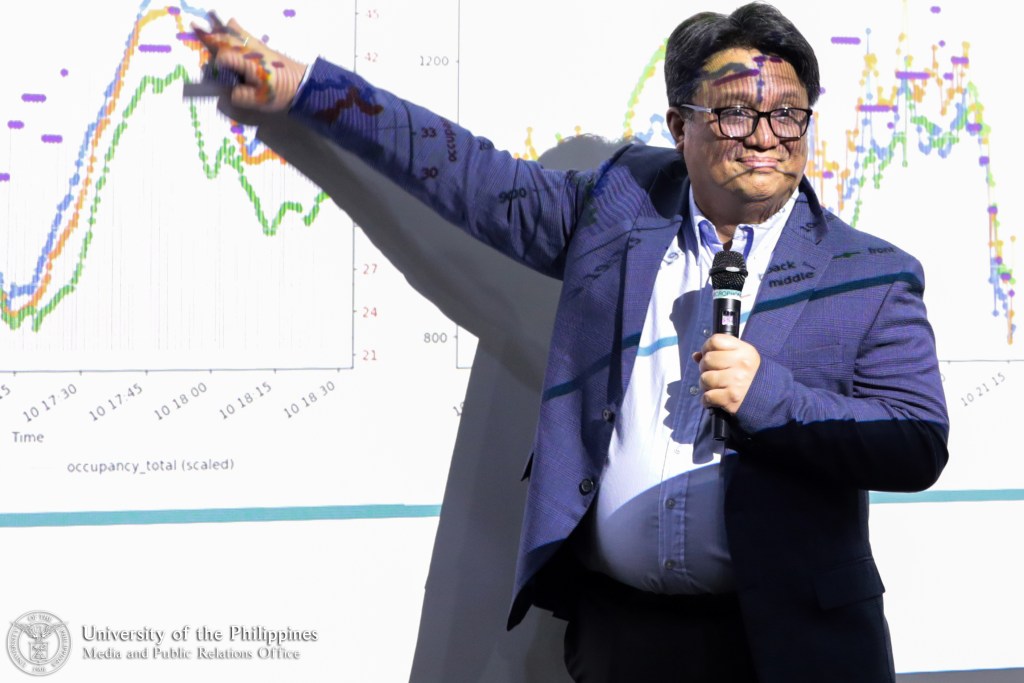
“We make you see the air you breathe.”
This was the bold statement of the UP Center for Air Research in Urban Environments (UP CARE), an interdisciplinary research program that provides a platform for real-time air quality monitoring using low-cost customized technologies. Funded by the Department of Science and Technology, the program caters to researchers, government regulatory agencies, local government units (LGUs), and the general public.
UP CARE was the focal point in “Making the Invisible Visible: Democratizing Air Quality Monitoring Through Low-Cost Sensor Technology,” a roundtable discussion (RTD) on July 9 at the National Engineering Center, UP Diliman (UPD) organized by the Political Economy Program (PEP) of the UP Center for Integrative and Development Studies. The event was also an avenue for academic institutions, government agencies, local government units, and the private sector to share insights on the current state and innovations in air quality monitoring in the country.
Dr. Antoinette Raquiza, PEP convener, began the RTD by talking about the adverse effects of poor air quality, particularly in urban and industrial areas; then gave the floor to UP CARE’s Dr. Julius Rhoan Lustro, Project 4 leader, and Dr. Richard Hizon, program leader.
Lustro provided an overview of UP CARE Project 4, which aims to “make air quality visible” and accessible by utilizing low-cost sensors. He explained that his team employs low-cost engineering simulation tools to identify how pollutants move around in enclosed spaces. These simulations provide information on how to improve air quality, he added.
Building on Lustro’s discussion, Hizon stated that the high cost of air quality monitoring technologies available in the country prompted the development of UP CARE technologies. These include low-cost sensors and software applications. He also revealed that his team has deployed and installed a total of 36 sensors across the country, in partnership with LGUs.
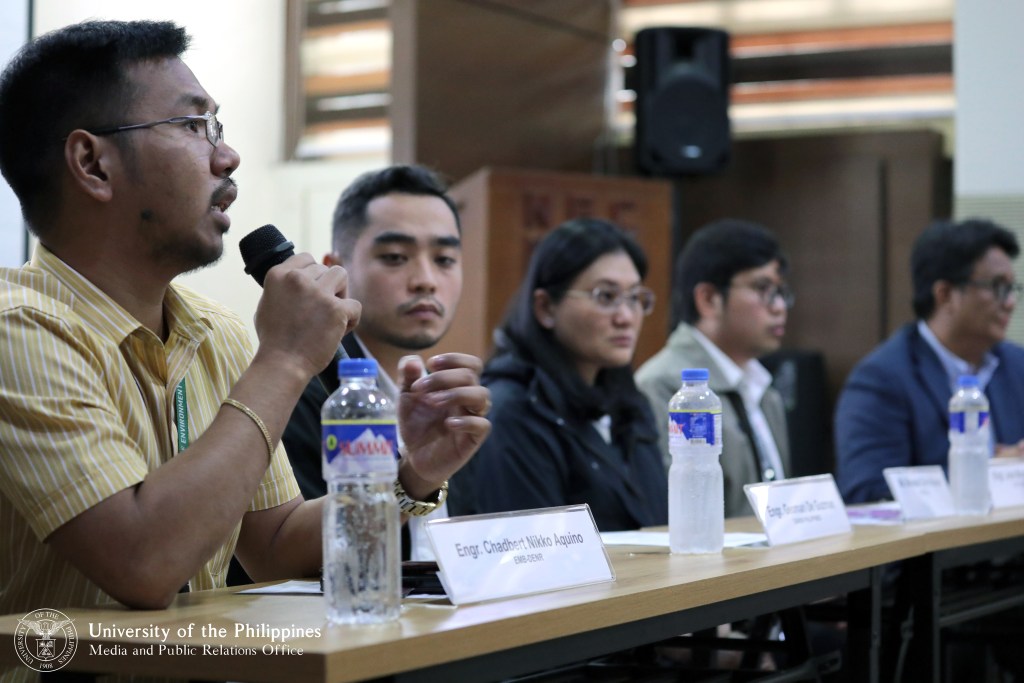
Representatives from partner government agencies, local government units, and the private sector later gave their messages in response to the project. The panelists were Engr. Chadbert Nikko Aquino, Engineer II at the Department of Environment and Natural Resources-Environmental Management Bureau (DENR-EMB); Engr. Raymar Fernando, industrial hygienist at the Department of Labor and Employment-Occupational Safety and Health Center (DOLE-OSHC); Engr. Geomari De Guzman, assistant manager for consulting sales of Daikin Airconditioning Philippines, Inc.; and Vanessa Claire Vinarao, acting division chief of the Climate Change Mitigation Division of the Quezon City Climate Change and Environmental Sustainability Department.
Aquino noted that UP CARE’s initiatives are aligned with DENR-EMB’s efforts, as the agency is currently updating its guidelines and policies concerning air quality.
Fernando delivered a message on behalf of DOLE-OSHC Executive Director Jose Maria Batino. He emphasized the importance of good indoor air quality in fostering a healthy and productive work environment.
De Guzman expressed interest in collaborating with UP CARE on developing solutions focusing on indoor air quality management.
Vinarao provided insights on the air quality monitoring efforts of Quezon City, one of the areas included in UP CARE’s research. Vinarao added that data from sensors help form LGU policies, such as those on school suspensions based on air quality levels.

In her synthesis of the RTD, Dr. Mylene Cayetano of the UPD Institute of Environmental Science and Meteorology additionally called for continued interdisciplinary collaboration among academic institutions, government, and the private sector toward cleaner air and healthier communities.
Raquiza capped off the event by emphasizing the need for science-based policymaking. She expressed hope that the event may spark more conversations and forge collaborations that will benefit Filipinos.

For more information about UP CARE and its projects, visit https://www.upcare.ph/.


